Mental Health Awareness: Why It Matters More Than Ever

Mental Health Awareness: Why It Matters More Than Ever


Mental Health Awareness Why It Matters More Than Ever

Mental health awareness is the ongoing effort to recognize the importance of emotional, psychological, and social well-being. It involves educating people about mental health conditions, understanding their symptoms, and encouraging individuals to seek help when needed. By increasing awareness, communities can foster empathy, reduce stigma, and improve access to support and treatment for those facing mental health challenges.


What Is Mental Health Awareness?

Mental health awareness focuses on helping people better understand the role mental well-being plays in everyday life. It encourages open conversations about mental health, promotes early recognition of potential issues, and highlights the importance of professional support when necessary.

Raising awareness is essential because mental health affects how people think, feel, and behave. It also influences how individuals handle stress, build relationships, and make decisions. When people are informed about mental health, they are more likely to recognize warning signs in themselves and others and take action before problems become more severe.


Why is Mental Health Awareness Important?

Mental Health Awareness Month educates people about the impact of mental illness on individuals’ lives, regardless of their personal experiences. It also highlights available services and resources for those facing mental health challenges, and promotes ways to advocate for mental health. 3

Raising mental health awareness and engaging in its related activities is important for several reasons, such as:

1. To Reduce Stigma

The stigma surrounding mental health can prevent individuals 4 from seeking help and can lead to discrimination. Raising awareness can help reduce stigma and promote acceptance and understanding.

2. To Increase Access to Resources

Many people may not know where to turn for help with mental health issues. Mental health awareness raises the profile of mental health issues, making it easier for people to access the help and support they need. and support services.

3. To Promote Early Intervention

Early intervention is crucial for treating 5 mental health issues. By raising awareness and promoting early intervention, we can help individuals receive treatment before their symptoms worsen.

4. To Improve Overall Well-being

Mental health issues can impact all aspects 6 of an individual’s life, including relationships, work, and physical health. Raising awareness and promoting mental health can improve overall well-being and quality of life.

5. To Reduce the Economic Impact

Mental health awareness presents a chance for fundraising 7, outreach, and awareness activities, which can aid in financing treatment options, supporting research, and bringing advocates together to establish a more optimistic and promising future for mental health care.
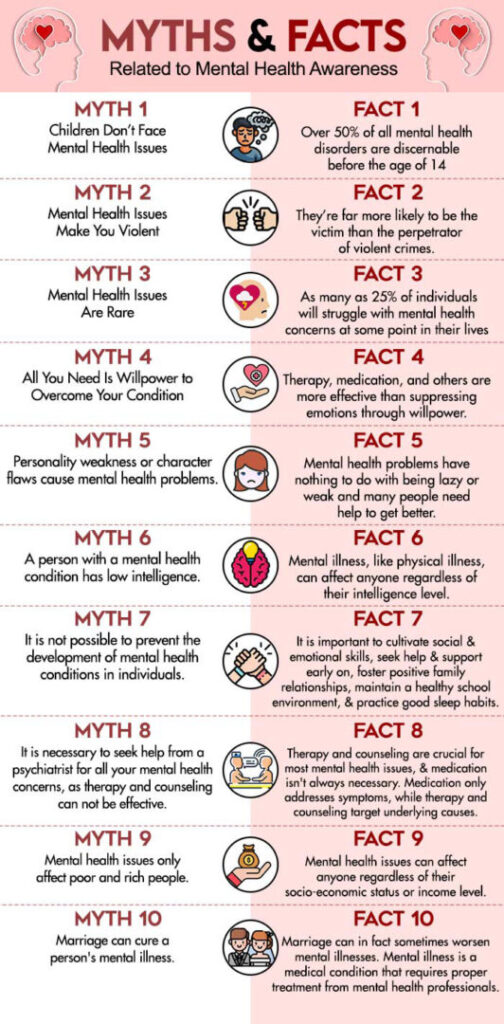
Myths and Facts Related to Mental Health Awareness


Mental Health Awareness in Different Stages of Life

Here are some considerations for mental health awareness in different stages of life:

1. Childhood

Mental health awareness during childhood is crucial 8. It sets the foundation for future mental health and helps children develop resilience. Awareness can also reduce the risk of mental health issues that can arise in adulthood.

2. Adolescence

Mental health awareness is crucial during adolescence because this is a critical period of development when young people undergo significant physical, emotional, and social changes. Adolescents may also face various challenges 9 and stressors, such as academic pressures, peer relationships, family conflict, and identity formation.

It is essential to be aware of the possibility of schizophrenia during adolescence because early intervention is critical for preventing the symptoms of schizophrenia such as hallucinations, delusions, disorganized speech, and social withdrawal.

3. Adulthood

Mental health awareness during adulthood helps recognize signs and symptoms 10, seek treatment, and develop healthy coping strategies.

Additionally, mental health awareness can help to understand the cultural and contextual dimensions of mental-health conditions of youth, making it easier to increase the understanding of the support system without fear of judgment or discrimination.

4. Old Age

Mental health awareness is important in older age 11 because as individuals age, they may face physical and cognitive decline, as well as loss of loved ones and social isolation, which can increase the risk of mental health issues such as depression and anxiety.

To increase awareness of mental health in older age, it is important to educate older adults 12 and their caregivers about the signs and symptoms of mental health issues which can be done through community programs, educational initiatives, and outreach efforts.


Men’s and Women’s Mental Health Awareness

Men and women may require different mental health approaches as they face mental health challenges differently, such as:

1. Gender Differences

Men and women experience different types 13 of mental health issues. Women are more likely to experience depression and anxiety, while men are more likely to experience substance abuse and addiction. Additionally, men are less likely to seek help for mental health issues than women, which can lead to a greater risk of suicide and other negative outcomes.

2. Stigma Associated with a Particular Gender

There is still a significant stigma associated with 14 mental health issues for both men and women, but the stigma can manifest differently depending on gender.

For example, women may be more likely to be labeled as “emotional” or “overreacting” when seeking help for mental health issues, while men may be labeled as “weak” or “unmanly” for seeking help. This can prevent individuals from seeking help and contribute to the negative impact of mental health issues.

This needs to stop. We must put an end to this unfair stigma and ensure that people of every gender feel comfortable getting help when they need it. There’s nothing wrong with asking for help.

3. Promoting Gender Equality

The importance of mental health awareness may promote gender equality 15 by reducing the stigma associated with mental health issues and encouraging individuals of all genders to seek help when needed.


Why Mental Health Awareness Month is Celebrated?

Every year on October 10th 16, World mental health day is celebrated to raise global awareness about mental health issues. Since its inception in 1992, this day has gained significant recognition worldwide. The color green, symbolizing hope, life, and renewal, is associated with this day.

In addition to World mental health day, May is recognized as mental health awareness month and the goals for celebrating 17 mental health awareness month include:

  • To raise awareness about the importance of mental health and mental illness.
  • To promote understanding and empathy for people with mental health conditions.
  • To reduce the stigma surrounding mental health issues.
  • To encourage individuals to seek help when needed.
  • To increase knowledge about mental health issues and treatments facilities.
  • To advocate for improved mental health resources and support services.


How to Spread Awareness about Mental Health

There are several ways to build awareness 18 about the importance of mental health, such as:

  • Promote mental health education in schools and workplaces.
  • Organize mental health awareness events and activities in the community.
  • Encourage open communication and discussion about mental health among family and friends.
  • Share stories and experiences of individuals with mental health issues to reduce stigma and promote understanding.
  • Train healthcare professionals and first responders to recognize and respond to mental health crises.
  • Advocate for improved access to mental health resources and support services.
  • Use social media and other platforms to raise awareness about mental health issues and resources.
  • Partaking in mental health campaigns that are focused on themes such as self-care, stress awareness, etc.

Incorporating the ways to promote mental health awareness in everyday life 19 include:

1. Practice Self-care

Make self-care a priority in your daily routine. That could mean taking breaks when needed, getting enough sleep, eating a healthy diet, or exercising regularly.

2. Be Mindful of Your Mental Health

It is important to pay close attention to your mental health on a regular basis. If you notice any significant changes in your feelings or behaviors, or if you are struggling, you should seek help from a mental health professional right away.

3. Educate Yourself

Read up on mental health issues and resources so you can recognize symptoms, understand treatments, and advocate for yourself and others.

4. Speak Up

Don’t be afraid to talk openly about mental health and share your experiences or knowledge with others. This can help reduce stigma and promote understanding.

5. Prioritize Mental Health in Relationships

EncourageOpenCommunication #SupportMentalHealth

It’s important to support mental health in your relationships with family, friends, and colleagues. To do this, encourage open communication with your loved ones.

6. Create a Safe Space

Foster a safe and supportive environment where mental health can be discussed and addressed without judgment or stigma.

7. The Daily Practice of Yoga and Meditation

Regular yoga and meditation practice can help 20 you to reduce stress and promote overall mental health and well-being.

8. Practice Empathy and Compassion

Show empathy and compassion towards others who may be struggling with mental health issues.

9. Take a Mental Health Screening

Taking a mental health screening can be a proactive step in managing your well-being. It helps identify potential mental health concerns early, offering an opportunity to seek appropriate treatment and support. 21.

10. Join as a Volunteer in a Mental Health Camp

Consider getting involved in a mental health camp or community event as a volunteer. It can help raise awareness about mental health issues and promote access to resources and support for those affected. 22


Takeaway

Promoting mental health awareness is essential in reducing stigma and encouraging individuals to seek help when needed. It can be integrated into daily life by prioritizing mental health in relationships, creating a safe space for discussion, supporting mental health initiatives, practicing self-care, and cultivating empathy. These steps will make it easier to promote mental health and well-being for everyone.


At A Glance

  1. Mental health awareness is important for reducing stigma, promoting understanding, and improving access to resources and support services.
  2. Mental health awareness can be incorporated into everyday life through self-care, education, empathy, speaking up, supporting mental health initiatives, prioritizing mental health in relationships, and creating a safe space for discussion.
  3. Mental health awareness is essential in all phases of life, including childhood, adolescence, adulthood, and old age.
  4. Men’s and women’s mental health awareness differ regarding stigma, prevalence, and treatment approaches.
  5. Mental health awareness month is celebrated to raise awareness about mental health issues and promote understanding.
  6. The ways to promote mental health awareness involve organizing events and activities as well as sharing stories and experiences.


Frequently Asked Questions (FAQs)

1. What are some warning signs of a mental health problem?

Warning signs of a mental health problem can include changes in mood or behavior, difficulty concentrating, withdrawal from friends and family, changes in sleeping or eating habits, substance abuse, and suicidal thoughts or behaviors.

2. Where can I go for help if I struggle with a mental health problem?

There are many resources available for people struggling with mental health problems, including mental health professionals (such as therapists and psychiatrists), support groups, crisis hotlines, and online resources such as self-help websites and forums.

3. How can I help someone who is struggling with a mental health problem?

Anyone can help an individual who is struggling with a mental health problem by offering emotional support, listening without judgment, helping them access professional help, and encouraging them to take care of themselves through healthy habits such as exercise and self-care.

4. What color is Mental Health Awareness Month?

The color associated with Mental Health Awareness Month is green. The color green is often used to symbolize hope, renewal, and good mental health.

5. Who introduced mental health day?

The idea of World Mental Health Day was first proposed by Richard Hunter, the Deputy Secretary General of the World Federation for Mental Health (WFMH), in 1992.

6. Who invented mental health awareness?

Mental Health Awareness Month has been observed in the United States since 1949 and was initiated by the Mental Health America (MHA) organization, which was then known as the National Association for Mental Health. The purpose of this month-long observance is to raise awareness about mental health and reduce the stigma surrounding mental illness.


Feeling Lonely? Try These 5 Proven Strategies to Feel Better

Feeling Lonely? Try These 5 Proven Strategies to Feel Better


Feeling Lonely? Try These 5 Proven Strategies to Feel Better

Loneliness is a powerful emotional experience that can affect anyone, no matter their age or lifestyle. It’s not simply about being alone—it’s about feeling disconnected, unseen, or emotionally distant from others. In fact, you can be surrounded by friends, family, or even a large crowd and still struggle with deep feelings of loneliness.


Overcoming loneliness takes more than waiting for things to change on their own. It requires self-awareness, understanding the root of your emotions, and taking small but meaningful steps toward connection and healing. While the process may not always feel easy, it is absolutely possible to regain a sense of happiness, purpose, and emotional balance.


The first step is recognizing what triggers your loneliness and learning how to respond in healthier ways. Once you understand your feelings better, you can begin building habits and relationships that help you feel more connected and supported in everyday life.


Understand that loneliness is a feeling

overcome loneliness understand feeling
Unsplash

The reason you might feel alone even in a crowd is that loneliness is a feeling that can show up detached from reality.

To overcome loneliness you really need to understand this: since there is no reason for you to be feeling like that, the brain will try to make sense of it. Why are you feeling lonely? Is it because you’re a loser? No one loves you? Your friends don’t care about you?

Your brain will really try hard to find a reason. So hard that it will look for signs where they don’t exist.


Disconnect from social media

This might look counterintuitive since you’re feeling alone and social media help you feel connected, but more likely than not it is one of the causes for your loneliness.

According to a 2017 study, young American adults with a high social media use tend to feel more isolated than their counterparts with a lesser use. The reasons are not clear, but it can stem from the fact that on social media everyone looks happy and is constantly engaged in fun or interesting activities.

This can make you feel like an outsider and a loner since you’re not as engaged as them or don’t have such a big network of friends.


Reach out to others

overcome loneliness reach out to others
Unsplash

Loneliness can be very painful and you might try to close yourself down in a cacoon in an attempt to escape it. Instead, try to reach out to others.

Talk with friends and family about what is happening and how you are feeling. Maybe they will say the right thing that will help your brain to understand what is going on and get rid of the self-deprecating thoughts.

Hanging out with people you enjoy spending time with also works as a distraction. While you’re having fun or listening to other people’s stories you’re not focused on your own feelings. Even if this trick doesn’t work to overcome loneliness at least it will provide a moment of relief.


Think positive

Try to be aware of your thoughts and distinguish the regular ones from those stemming from loneliness. The latter are usually negative, even depressing, and they always have a hint of self-deprecation.

If you become aware of these, then you can actively try to switch your attention to the positives. If your brain is telling you that you have no friends, try to remember that just that day someone texted you asking how you were doing, for instance.

It’s almost a battle against yourself. Your brain throws you a negative idea, and you need to think of a rebuttal quickly to invalidate its argument.


Try new things and stick to them

overcome loneliness new things
Unsplash

Your feelings of loneliness can also be real, and not just an unbalanced brain reaction.

You have friends and family that love you, but they live far away, for instance. Maybe they are all happily married with children and, as much as they wanted to, they can go to you when you need.

It might be hard, but you need to put yourself out there in these cases. Maybe enroll in some group classes.

Regardless of what you choose, try more than one before you settle on the one you like. For instance, if you want to have a go at yoga, try more than one class. You won’t know anyone there, but you should feel comfortable doing your thing and not as if you were being scrutinized or left aside.

If you have good vibes from a group, chances are you won’t even have to try and make friends. The conversation will come naturally and while at it, you’re doing something for your body and self-growth.


Signs you’re suffering from chronic loneliness

The signs of chronic loneliness almost the same as those of depression. Mostly because loneliness is itself a common symptom of depression too.

The key to identifying it’s in its name. If it is chronic it means is not just a phase and it likely affected other areas of your life already, even your health. The most common symptoms are:

  • You can’t remember when you first began feeling like that.
  • You struggle with anxiety.
  • You have trouble falling asleep and resting.
  • Your memory becomes faulty.
  • You have unstable blood pressure.
  • You can’t manage your diabetes.
  • You get sick often.
  • You take long showers and baths.

This last symptom might look out of place, but people with chronic loneliness tend to do this without realizing it because their bodies crave for any kind of warm contact.


5 Powerful Life Rules by Carl Jung Everyone Should Know

5 Powerful Life Rules by Carl Jung Everyone Should Know


5 Powerful Life Rules by Carl Jung Everyone Should Know

During the time of the Roman Empire, an enormous network of roads was built to connect distant regions. These roads were designed so that the most important routes eventually led back to the heart of the empire — the city of Rome.

That’s where the famous phrase “all roads lead to Rome” originated.

In a similar way, whenever I explore ideas about philosophy, psychology, mental health, or even spirituality, my thoughts often lead me back to one remarkable figure: Carl Jung. In a sense, his ideas are like the central hub in my mind’s network of reflections.

So come along as we travel different paths that ultimately return to one of Jung’s most meaningful insights.

Here are five simple rules for living a happier life, inspired by Carl Jung.


1. Befriend Your Shadow

Our shadow is all the things we deny, suppress, or ignore. It’s our fears, behavioural patterns, coping mechanisms, and blind spots. It can even be our belief and value systems if we’ve adopted them from someone (or society) without much scrutiny.

I found it extremely confronting to discover that the only way for me not to be anxious was to go into all the reasons why I lived with anxiety. I had to accept and love those parts of myself instead of pushing them away or trying to fix them. Only then did anxiety start to soften.

Robert Frost once said, “The only way over is through.” I think that’s spot on.

Suppressed emotions are like holding a beach ball underwater. Eventually, they’ll shoot to the surface when we least expect them.

It could manifest as an over reaction to something small, it could show up in your dreams or disrupt your sleep, or at worst, it could turn into illness and/or disease. All of those things happened to me.

That’s why Carl Jung suggested that we befriend our shadow. Otherwise, it will find a way to make itself known in unwanted ways.

Once I finally built up enough courage to look inside, I learned a lot about who I am, where I’ve come from, and why I think and feel the way I do.

It scary in the beginning, but then curiosity began to take the place where anxiety used to be and then it became quite fun.

“One does not become enlightened by imagining figures of light, but by making the darkness conscious.” — Carl Jung


2. Follow Meaning, Not Pleasure

Carl Jung believed that humans need purpose in life, not mere pleasure or avoidance of discomfort.

Meaning can be so many different things. It can be a spiritual practice, raising a family, building a business, growing a garden, working out, being in a community, seeing friends, looking after animals, or simply residing in the present moment with pure awareness.

Each one comes with its own set of challenges, but doing anything worthwhile has its ups and downs. Following meaning and not jumping to what’s pleasurable all the time allows us to stick with things that benefit our lives longer term.

Writing full-time gives me a lot of meaning, but there are many days when I’m struggling to put words on the page. Sometimes I just want to curl up in bed and watch Netflix.

I don’t do that (most of the time) because I know that’s not what I want deep down. What I want deep down is to learn and grow, and sometimes that comes with growing pains.

I have to remind myself that, however lovely and necessary pleasure is from time to time, it’s fleeting. Meaning has deeper roots.

So I sit down and tap the keys until something worth publishing comes out of me.

This article came about in that way.

“The least of things with a meaning is worth more in life than the greatest of things without it.” — Carl Jung

3. Become whole, not perfect

It was such a relief to learn that becoming whole involved accepting all of my flaws and imperfections instead of trying to get rid of them.

Trying to get rid of them was exhausting. It further added to the idea that I was broken and needed fixing. Acceptance, on the other hand, allowed me to be more compassionate and loving with myself.

It reminded me that a smashed pot needs to be put back together again with all the pieces that are apart. If one piece is missing or not included — however chipped, stained, or lost it might be — it’s incomplete.

If parts of myself aren’t fully integrated, I’m fragmented.

That’s not how I want to live my life.

“Wholeness is not achieved by cutting off a portion of one’s being, but by integration of the contraries.” — Carl Jung


4. Get to know your Persona

If you’re anything like me, you won’t be yourself everywhere you go in life. There will be times when you’re more polite than you want to be. There’ll be times when you withhold what you really think and feel. There’ll be times when you say “I’m good” because you know it’s too raw to share how you really feel with a complete stranger.

We all have a mask (or many masks), and that’s ok. Sometimes it’s quite helpful.

The goal is just to get to know these masks so you know when you’re wearing them and why.


Luckily, I met a mentor who took me under his wing 15 years ago and told me, “Don’t confuse the mask with the real you.”

Later I learned that Carl Jung referred to this as the path to individuation. The older I get, the more I’m trying to honour this way.

“The privilege of a lifetime is to become who you truly are.” — Carl Jung


5. Integrate your opposites

Carl Jung believed that in each man and woman lies a masculine and feminine counterpart. He called this anima and animus.

The anima is the feminine side in a man’s psyche; the animus is the masculine side in a woman’s psyche.


For me, being a sensitive man who is more in touch with his feminine side, my work has been to come into my masculine side. I’ve had to learn how to speak my truth and set boundaries without being a defensive asshole. For other men, it’s the other way around.

Whatever it might be, the goal is to balance both our masculine and feminine sides so that the logical and emotional parts, the spiritual and material parts, and the light and darker parts can become one cohesive whole.

That’s how to create real harmony.

That’s how to embody Carl Jung’s five rules in life.

That’s what’s had a profound impact on my life.


7 Simple Ways to Improve Your Mental and Physical Wellbeing

7 Simple Ways to Improve Your Mental and Physical Wellbeing


7 Simple Ways to Improve Your Mental and Physical Wellbeing

The mind and body work closely together, which is why mental health and physical health are deeply connected. When one is affected, the other often follows. Taking care of both is essential for overall wellbeing and long-term health.


There are various types of mental health conditions, with some of the most common including anxiety disorders, mood-related conditions such as depression and schizophrenia, and substance-related disorders involving alcohol or other substances.


Studies consistently show that individuals experiencing mental health challenges are more likely to develop preventable chronic illnesses. These can include heart disease, stroke, diabetes, digestive problems, and long-term pain conditions.


Mental health struggles can also interfere with everyday life. For instance, depression may cause persistent tiredness, headaches, and stomach issues, while anxiety is often linked to sleep disturbances, restlessness, and difficulty focusing.


In addition, people dealing with poor mental health may turn to unhealthy coping behaviors, such as smoking, excessive alcohol consumption, or avoiding physical activity, which can further increase health risks.


Mental Health Affects Everyone

Mental health challenges are widespread and affect people across all age groups. Research indicates that millions of adults experience mental health issues each year, and a significant number of them also live with ongoing physical health conditions. This overlap highlights how closely mental and physical wellbeing are connected.

The impact extends beyond the individual. Mental health issues can influence quality of life, increase healthcare needs, and reduce life expectancy. They can also affect families and communities by influencing income stability, child development, educational outcomes, and overall social equality.


The Importance of Prevention and Early Support

Because mental and physical health are so closely linked, prevention and early intervention play a crucial role. Supporting mental wellbeing early can help reduce the risk of chronic disease, improve daily functioning, and enhance long-term quality of life.

By adopting simple, healthy habits and seeking support when needed, it is possible to protect both mental and physical health and create a stronger foundation for overall wellbeing.


7 ways to look after your mental wellbeing

1. Get moving

Physical activity releases feel-good chemicals like endorphins and serotonin in the brain to help improve mood. Engaging in physical activities with others, whether as a shared experience or in a group, also helps build social connections, which further protects your mental wellbeing. Aim for 30 minutes of physical activity each day, though even a 10-minute brisk walk can help boost mental alertness, energy and mood. Finding an activity that you enjoy, like walking, cycling, swimming, dancing, or gardening can help make regular physical activity more attainable.


2. Eat well

The food we eat can influence the development, management and prevention of numerous mental health conditions, including depression and dementia [1]. Eating a well-balanced diet that includes a healthy amount of protein, essential fats, complex carbohydrates, vitamins, minerals and water can improve your mood and your health.


3. Get enough sleep

Good quality sleep is an essential component to living a healthy life as it is the body’s opportunity to rest.

Try to establish a healthy sleep routine by going to bed and waking up around the same time each day, including on weekends or your days off. Adults need 7 hours of sleep or more each night, so send yourself to bed at an appropriate time.

To induce sleep, try and reduce your exposure to blue light from phone screens, TVs or computers at least 2-3 hours before bedtime.


4. Quit smoking

Some people with poor mental health believe that smoking relieves their symptoms, but these effects are only short-lived.

In the long term, smoking actually increases anxiety and tension and encourages the brain to switch off its mechanism to produce the “feel good” chemical dopamine, creating a vicious cycle of nicotine addiction.

Talk to your doctor or contact Quit HQ for support to quit smoking once and for all.  


5. Manage your stress

Stress can physically cause:

  • changes in appetite
  • changes in energy levels
  • digestive issues
  • headaches, and
  • sleep problems.

Learning to cope with stress in a healthy way can help you become more resilient to life’s challenges, to maintain your mental and physical health.

Meditation is an effective tool for slowing down overactive thoughts, focusing on the present, and calming your body. Walking, yoga, or tai chi are also great ways to manage stress.


6. Take breaks from social media and news stories

It’s good to be informed, but a continual bombardment of negative news stories or comparing ourselves to others online can be upsetting.

Consider limiting your exposure to news and social media content to a couple of times a day. Focus instead on connecting with friends and family, reading, or getting outdoors and appreciating small moments in your everyday life.


7. Connect with others

Our need to connect socially as humans is as basic as our need for food, water and shelter. Feelings of loneliness or isolation can lead to poor mental health outcomes.

Reach out to friends and family regularly and schedule quality time together. Join a group focused on your favourite hobby or interest, or challenge yourself to try a new activity outside of your comfort zone and see if you like it.

Volunteering is also a great way to find more purpose in your life and to connect with new people. Having different types of people in our lives can provide a greater variety of perspectives to help us with life’s many challenges.


It’s a work in process

Remember, mental health can change over time, depending on many factors. Prolonged stress or significant life changes, like working long hours, caring for a relative, ending a relationship, or economic hardship can all impact mental health.

Embracing healthy habits and prioritising your mental wellbeing every day can help you weather life’s many challenges, while remaining in great physical health to live life to the fullest.

Sources

1. Physical Health and Mental Health (Mental Health Foundation UK)

2. Improving Australia’s Mental and Physical Health – A Connected Approach (Mitchel Institute)

3. Physical Health of People with Mental Illness (Australian Institute of Health and Welfare)


Why Self-Love Is Essential for Better Mental Health

Why Self-Love Is Essential for Better Mental Health


Why Self-Love Is Essential for Better Mental Health

Self-love is not merely a popular buzzword or a passing trend. It plays a crucial role in supporting mental health and overall well-being. In today’s fast-paced world, constant pressure from society, social media, and personal expectations often leads to self-criticism and emotional exhaustion. This is why developing self-love is essential—it helps create balance, emotional stability, and a healthier mindset.

This article explores the meaning of self-love, its connection to mental health, and how practicing self-love can positively transform daily life.


Understanding Self-Love

Self-love means accepting and valuing yourself for who you truly are. It involves treating yourself with patience, compassion, and respect while making decisions that support your physical and emotional health. Contrary to common misconceptions, self-love is not selfish or narcissistic. Instead, it is about acknowledging your worth and taking responsibility for your well-being.

Practicing self-love includes showing yourself compassion during difficult moments, respecting personal boundaries, and prioritizing self-care. It also means allowing yourself to make mistakes without harsh self-judgment and recognizing that you deserve happiness and inner peace.


How Self-Love Affects Mental Health

Self-love and mental health are closely connected. When you develop a positive relationship with yourself, you build emotional resilience and a stronger sense of self-worth. This makes it easier to cope with stress, manage negative emotions, and handle life’s challenges in a healthier way.

On the other hand, neglecting self-love can increase the risk of mental health struggles such as anxiety, depression, and chronic self-doubt. Constant self-criticism and unrealistic expectations can drain emotional energy and negatively affect overall mental well-being.

By practicing self-love consistently, individuals can foster a more positive mindset, improve emotional balance, and strengthen their mental health over time.    


1. Reducing Self-Criticism and Negative Thoughts

One of the most significant ways self-love impacts mental health is by reducing self-criticism. Negative self-talk and harsh self-judgment can lead to a cycle of low self-esteem and mental distress. When you practice self-love, you replace this negative inner dialogue with kindness and understanding, allowing yourself to be imperfect without harsh judgment.

For example, instead of berating yourself for a mistake, self-love encourages you to view it as a learning opportunity. This shift in perspective can alleviate feelings of guilt and shame, leading to a more positive and compassionate relationship with yourself.


2. Building Emotional Resilience

Self-love also plays a crucial role in building emotional resilience. Life is filled with challenges, setbacks, and disappointments. When you have a strong sense of self-love, you are better equipped to navigate these difficulties without being overwhelmed. You understand that your worth is not dependent on external circumstances or the approval of others.

By cultivating self-love, you develop a sense of inner strength that allows you to bounce back from adversity. You become more capable of handling stress, managing your emotions, and maintaining a positive outlook even in difficult times.


3. Enhancing Self-Esteem and Confidence

Self-love is closely tied to self-esteem. When you love and value yourself, you naturally develop a healthy sense of self-worth. This, in turn, boosts your confidence and allows you to pursue your goals and dreams with greater determination.

People with high self-esteem are more likely to take risks, embrace new opportunities, and assert themselves in social and professional situations. They are also less likely to be affected by criticism or rejection, as their sense of self-worth is not dependent on external validation.


4. Promoting Healthy Relationships

The way you treat yourself sets the tone for how others treat you. When you practice self-love, you establish boundaries, communicate your needs, and seek relationships that are supportive and nurturing. You are less likely to tolerate toxic behavior or settle for less than you deserve.

Healthy relationships are built on mutual respect, trust, and love. By loving yourself first, you create a strong foundation for forming and maintaining positive connections with others. You also become a better partner, friend, and family member, as you are able to give and receive love more freely and authentically.


5. Encouraging Self-Care and Well-Being

Self-love naturally leads to self-care. When you value yourself, you prioritize your physical, emotional, and mental well-being. This means taking care of your body through regular exercise, nutritious eating, and adequate rest. It also means nurturing your mind and spirit through activities that bring you joy, relaxation, and fulfillment.

Self-care is not a luxury; it is a necessity for maintaining mental health. By making self-care a regular part of your routine, you replenish your energy, reduce stress, and enhance your overall quality of life.


Practical Ways to Cultivate Self-Love

Cultivating self-love is an ongoing process that requires intentional effort and practice. Here are some practical strategies to help you develop a deeper sense of self-love:


1. Practice Self-Compassion

Self-compassion is the foundation of self-love. It involves treating yourself with the same kindness and understanding that you would offer to a friend. When you make a mistake or face a challenge, instead of being self-critical, acknowledge your feelings and remind yourself that it’s okay to be imperfect.

To practice self-compassion, start by becoming aware of your inner dialogue. Notice when you are being harsh or judgmental and consciously replace those thoughts with more compassionate ones. For example, instead of thinking, “I’m such a failure,” try saying, “I’m doing my best, and it’s okay to make mistakes.”


2. Set Healthy Boundaries

Setting boundaries is an essential aspect of self-love. It involves protecting your time, energy, and well-being by saying no to things that drain you or do not align with your values. Boundaries help you maintain a sense of balance and prevent burnout.

To set healthy boundaries, start by identifying areas of your life where you feel overwhelmed or taken advantage of. Then, communicate your needs clearly and assertively to others. Remember, setting boundaries is not about being selfish; it’s about honoring your worth and taking care of yourself.


3. Engage in Self-Care Practices

Self-care is a tangible expression of self-love. It involves taking deliberate actions to nurture your physical, emotional, and mental health. Self-care practices can vary from person to person, but they should always bring you a sense of well-being and fulfillment.

Some self-care practices include:

  • Physical Self-Care: Regular exercise, healthy eating, adequate sleep, and relaxation activities like yoga or stretching.

  • Emotional Self-Care: Journaling, talking to a therapist, practicing gratitude, and spending time with loved ones.

  • Mental Self-Care: Engaging in hobbies, reading, learning new skills, and setting aside time for reflection and meditation.

Make self-care a non-negotiable part of your routine. Even small acts of self-care, such as taking a short walk or enjoying a quiet cup of tea, can have a significant impact on your mental health.


4. Celebrate Your Achievements

Acknowledging and celebrating your achievements, no matter how small, is a powerful way to cultivate self-love. Recognizing your progress and successes reinforces your sense of self-worth and motivates you to continue striving for your goals.

Take time each day to reflect on what you’ve accomplished. Whether it’s completing a work project, overcoming a personal challenge, or simply getting through a tough day, give yourself credit for your efforts. You deserve to be proud of yourself.


5. Surround Yourself with Positive Influences

The people you surround yourself with can significantly impact your self-love journey. Seek out relationships that uplift and support you, and distance yourself from those that bring negativity or drain your energy.

Surrounding yourself with positive influences also includes the content you consume. Choose books, podcasts, and media that inspire and empower you. Be mindful of social media use and curate your feed to include accounts that promote self-love and mental well-being.


6. Practice Gratitude

Gratitude is a simple yet powerful practice that can enhance your sense of self-love. By focusing on the positive aspects of your life, you shift your attention away from what you lack and toward what you appreciate.

Start a daily gratitude practice by writing down three things you are grateful for each day. These can be big or small, and they don’t have to be directly related to yourself. Over time, this practice can help you develop a more positive outlook and a greater appreciation for yourself and your life.


7. Forgive Yourself

Holding onto past mistakes and regrets can weigh heavily on your mental health. Practicing self-forgiveness is a crucial step in cultivating self-love. It involves letting go of the past and accepting that everyone makes mistakes.

To forgive yourself, start by acknowledging the mistake and taking responsibility for it. Then, remind yourself that mistakes are part of being human and that they do not define your worth. Finally, make a conscious decision to release the guilt and move forward with a renewed sense of self-compassion.


Conclusion

The power of self-love for mental health cannot be overstated. By cultivating self-love, you create a strong foundation for mental resilience, emotional well-being, and overall happiness. Self-love is not a destination; it is a journey that requires ongoing practice and commitment. By embracing self-compassion, setting healthy boundaries, engaging in self-care, and surrounding yourself with positive influences, you can nurture your mental health and lead a more fulfilling life.

Remember, self-love is not about being perfect; it’s about being kind to yourself, honoring your worth, and taking care of your mind, body, and soul. Start your self-love journey today, and watch how it transforms your mental health and enriches your life.


What Is Positive Thinking? 5 Simple Ways to Build a Positive Mindset

What Is Positive Thinking? 5 Simple Ways to Build a Positive Mindset


What Is Positive Thinking? 5 Simple Ways to Build a Positive Mindset

Positive thinking is a mental and emotional approach that encourages optimism, resilience, and constructive thinking. It focuses on expecting favorable outcomes while maintaining a realistic view of life’s challenges. Rather than ignoring difficulties, positive thinking helps you respond to them with confidence, clarity, and emotional balance.


A person with a positive mindset believes in possibilities. They learn to see opportunities where others see limitations, stay hopeful during uncertainty, and remain motivated even when facing setbacks. Over time, this attitude can significantly influence personal growth, career success, and overall well-being.

Understanding Positivity Beyond Optimism

Positivity is often misunderstood as constantly being happy or smiling all the time. In reality, it is much deeper than surface-level cheerfulness. A positive mindset reflects how you interpret situations, manage stress, and choose where to focus your energy.

Being positive means recognizing what truly matters in your life, practicing gratitude, and developing emotional awareness. It allows you to stay grounded while maintaining hope, even during difficult moments.

Positive thinking is not something you are born with—it is a skill and a habit that can be trained and strengthened over time.

How to Have a More Positive Mindset

Everyone has the ability to cultivate a more positive mindset with consistent practice and the right strategies. By developing healthy mental habits, you can create a lasting foundation for emotional stability and personal success.

Below are five key characteristics that can help you build and maintain a positive mindset, allowing you to manage emotions more effectively and guide your thoughts in a healthier direction.


5 Characteristics for a More Positive Mindset

Here are five examples of important characteristics and personality traits required to develop a positive mindset.

1. Optimism Unlocks Change

Why is optimism important for success? Optimism is a form of positive thinking that is focused on the future and how the future will unfold. Being aware of this tool helps improve our lives and helps us to feel more happier.


Pessimistic people are often choose to be defined by their past experiences and choose to use them as an excuse to progress. Afterall, being optimistic is a choice. 


We can become more optimistic by choosing to remember past successes which will allow us to place a positive spin on events that have not even taken place yet. What is the difference between optimist and pessimist?


    A pessimist often sees the difficulty in every opportunity; an optimist sees the opportunity in every difficulty. Winston Churchill

Focusing on becoming more optimistic allows for a willingness to try and make an effort and take a chance instead of assuming your efforts won’t pay off or you will fail.


Struggle makes us mentally stronger. Moving out of our comfort zone makes us stronger. For example, when life feels good, we coast along without making any quantum leaps.


However, when we go through difficult moments and adversity at work or in life in general, optimism re-wires the brain to help us grow and achieve greater results.
Failure is not the end; it’s often the beginning of something great.


2. Acceptance Supports Progression

Why is acceptance important in life? Acceptance allows people to move forward. How? Accepting the situation is an important vessel that allows you to stop resisting and instead find the lesson.
When we accept and acknowledge situations which don’t turn out how you envisioned them, acceptance provides you with closure which leads to new beginnings.
Successful people often;

  •     Accept their current situation quickly.
  •     Learn from their mistakes.
  •     Grow stronger from their setbacks.


When understanding what is positive thinking in life, acceptance provides us with the mental peace to heal our self-pain.


3. Gratitude Helps Transform Your Attitude

How does gratitude affect your brain? From a psychological standpoint, reflecting on your life from time to time will help change your perspective and attitude. In short, reciting gratitude will transform your attitude.
The importance of gratitude in life cannot be underestimated. Gratitude and positive affirmations help you focus on what you have rather than what you don’t have.
Why is gratitude important at work & life? Being grateful for what you have will immediately change your focus and perspective on your life and how you see it.


Gratitude will help people to;

  •     Feel more positive emotions
  •     Relish good experiences
  •     Improve their physical and mental health
  •     Deal with adversity
  •     Sleep more peacefully
  •     Opens the door to stronger relationships


Waking up in the morning and being thankful for what you have makes for a more productive and peaceful life. 


4. Daily Mindfulness Reduces Stress

Practicing daily mindfulness increases our ability to regulate emotions, reduce chronic pain, decrease stress and depression. In short, mindfulness slows down this fast-paced world and allows you to calmly place things in perspective.
When learning about what is positive thinking, being mindful encourages your thought process to focus on the present rather than worry and stress about the past or the future.
How does mindfulness change the brain and body? For example, focusing on your breathing will help you;

  •     Calm your bodies heart rate.
  •     Slow down your nervous system.
  •     Lower cortisol levels.


5. Integrity Cleanses Your Mind

Integrity is the core quality of a successful and happy life.
Having integrity means being totally honest and truthful. Living your life more truthfully, honourably, righteously with others instead of deceitful and self-serving behaviour will achieve a greater sense of positivity.
Why is integrity important in the workplace? How you treat your fellow employees impacts how you feel which impacts how you conduct your life.
Living with integrity means you are honest with yourself and your thoughts.


What is Positive Thinking? Here is a Quick Recap

  •     Positive thinking is a mental and emotional attitude.
  •     Being positive is a choice.
  •     Positivity anticipates a successful outcome before it happens.
  •     Becoming more optimistic is a learned behaviour.
  •     Acceptance provides mental peace & helps us move on.
  •     Gratitude helps us to be thankful for what have.
  •     Being more mindful calms the body and mind.


Clean Space Clean Mind: Why Tidying Up Is Good For You?

Clean Space Clean Mind: Why Tidying Up Is Good For You?

Clean Space Clean Mind: Why Tidying Up Is Good For You?


Imagine entering a room that is free of clutter and where everything is in its proper place. It feels amazing, doesn't it? It's not merely a coincidence.

Our mental health is significantly impacted by clean environments. According to research, our mood, stress levels, and general well-being are all directly impacted by the condition of our homes and workplaces.

We'll examine the intriguing psychology of clean spaces and their potential impact on mental health in this blog article. 


The Science Behind Clean Spaces


Understanding the Connection

A clean environment does more than just please the eye. Studies have found a direct link between cleanliness and mental health. An orderly space creates a sense of calm and control, reducing anxiety and stress. When our surroundings are tidy, our minds can focus better, and we feel more in control of our lives.


The Impact of Clutter

Clutter can be overwhelming. It sends signals to our brains that work is never done, leading to feelings of stress and fatigue. A study by UCLA found that individuals who describe their homes as "cluttered" or full of "unfinished projects" were more likely to experience higher levels of cortisol, a stress hormone.


Cognitive Load and Decision Fatigue

A messy environment increases cognitive load, making it harder for our brains to process information. This leads to decision fatigue, where making even simple choices becomes exhausting. By keeping our spaces clean, we reduce cognitive load, allowing our minds to function more efficiently.


The Benefits of Clean Spaces


Reduced Stress and Anxiety

One of the most significant benefits of a clean space is reduced stress and anxiety. A tidy environment promotes relaxation and peace of mind. When everything is in its place, there's less to worry about, and you can focus on what truly matters.


Improved Focus and Productivity

Clean spaces enhance focus and productivity. When your surroundings are organized, your mind can concentrate better. This leads to increased efficiency and a sense of accomplishment. A Harvard Business Review article highlighted that employees in tidy workspaces are more productive and less likely to procrastinate.


Enhanced Mood and Well-being

A clean and organized space can boost your mood and overall well-being. It creates a positive atmosphere that encourages feelings of happiness and satisfaction. When your environment is clean, you're more likely to feel motivated and energized.


Practical Tips for Maintaining a Clean Space


Decluttering Strategies

Start with small steps. Dedicate 15 minutes each day to decluttering a specific area. Focus on one room at a time, and use the four-box method—label boxes as "Keep," "Donate," "Recycle," and "Trash." This strategy helps you systematically reduce clutter without feeling overwhelmed.


Daily Cleaning Habits

Incorporate daily cleaning habits into your routine. Simple tasks like making your bed, washing dishes immediately after use, and putting things back in their designated places can make a significant difference. Consistency is key to maintaining a tidy environment.


Organizational Tools

Invest in organizational tools such as storage bins, shelves, and drawer dividers. These tools help keep items neatly stored and easily accessible. Labeling storage containers can also make it easier to find things quickly, reducing stress and saving time.


The Role of Mindfulness in Clean Spaces


Mindful Cleaning

Mindful cleaning involves being present and fully engaged in the act of cleaning. This practice can turn a mundane chore into a meditative experience. Focus on the sensory details—the sound of water, the feel of a cloth, the sight of a clean surface. Mindful cleaning can enhance your sense of accomplishment and bring a sense of calm.


Creating Rituals

Create cleaning rituals that you look forward to. Play your favorite music, light a scented candle, or reward yourself with a small treat after completing a task. These rituals can make cleaning enjoyable and help you maintain a positive attitude towards tidiness.


The Impact on Mental Clarity

Mindfulness and clean spaces go hand in hand. When you practice mindfulness while cleaning, you create a harmonious environment that promotes mental clarity. A clear space leads to a clear mind, allowing you to think more creatively and make better decisions.


Clean Spaces and Social Interactions


Hosting and Entertaining

A clean home is more inviting for guests. When your space is tidy, you're more likely to host and entertain friends and family. Social interactions are essential for mental health, and a clean environment makes these interactions more enjoyable and stress-free.


Reducing Social Anxiety

Cluttered spaces can contribute to social anxiety. The fear of judgment about your living conditions can deter you from inviting people over. By maintaining a tidy home, you reduce this anxiety and feel more confident in social situations.


Creating a Positive Atmosphere

A clean space sets a positive tone for interactions. It reflects your personality and values, creating a welcoming atmosphere for everyone. When guests feel comfortable, conversations flow more naturally, enhancing social bonds.


The Long-term Impact of Clean Spaces


Developing Healthy Habits

Maintaining a clean space helps develop healthy habits. Over time, these habits become second nature, leading to a more organized and stress-free life. Cleanliness fosters discipline and consistency, which can positively impact other areas of your life.


Boosting Self-Esteem

A tidy environment can boost your self-esteem. When you take pride in your living space, you feel a sense of accomplishment and self-worth. This positive self-image translates into other aspects of your life, increasing your confidence and motivation.


Enhancing Quality of Life

Ultimately, clean spaces enhance your quality of life. They create a nurturing environment that supports your physical and mental well-being. By prioritizing cleanliness, you're investing in your health and happiness.


The Advantages of Hiring Professional Cleaning Services

Professional cleaning services can play a crucial role in maintaining a clean and healthy environment, especially for those with busy schedules or larger spaces. Hiring experts to handle cleaning tasks ensures that your home or workplace remains consistently tidy and organized, which in turn supports your mental health and overall well-being. 


Professional cleaners have the expertise and equipment to tackle even the toughest cleaning challenges, reaching areas that might be overlooked in routine tidying. Additionally, they can personalize their services to meet your specific needs, ensuring a pristine space without taking up your valuable time. 


By investing in professional cleaning services, you alleviate the burden of maintaining cleanliness entirely on your own, reducing the stress and effort often associated with keeping spaces tidy. This allows you to focus on other important aspects of your life, fostering a more balanced and fulfilling lifestyle.


Conclusion

The psychology of clean spaces is a powerful reminder of the connection between our environment and mental health. 


A tidy space promotes relaxation, reduces stress, and enhances overall well-being. Hiring professionals for cleaning can be an effective way to maintain a clutter-free environment. 

By incorporating practical tips and mindful practices, you can support your mental clarity and productivity even further.