15 Effective Static Stretching Exercises to Enhance Any Workout Routine

15 Effective Static Stretching Exercises to Enhance Any Workout Routine


15 Effective Static Stretching Exercises to Enhance Any Workout Routine

When it comes to fitness, stretching is often overlooked in favor of more intense activities like strength training or cardio. Many people see stretching as optional—or something reserved for dancers, gymnasts, and athletes. In reality, static stretching can be a valuable addition to almost any fitness routine, regardless of your age, experience level, or workout goals.


Whether you're training for a sport, building strength, improving endurance, or simply staying active, incorporating static stretches into your routine can help support better movement and overall performance. Regular stretching may improve flexibility, ease muscle tension, enhance mobility, and contribute to more effective recovery after exercise.


In this guide, we'll explore 15 highly effective static stretches that can complement your workouts and help you move more comfortably. You'll also learn about the key benefits of static stretching and the best times to include these movements in your fitness routine for maximum results.


Benefits of Static Stretches

Static stretches come with tons of benefits that can help you make the most of your workout routine. Some of them include: 


Improved Flexibility

If you want to perform better, flexibility is of tremendous importance, irrespective of the specific workouts you do. Luckily enough, static stretches are all you need to get all the flexibility you desire.

Flexibility, also known as the range of motion (ROM) around a joint, has been shown by several studies to be improved by static stretching.[1]

Although the specific mechanism through which this occurs is still unclear, static stretches have been shown to greatly increase muscle and joint flexibility[2] and tissue length[3], which work in tandem to make your workout more effective. 


Prevent Injuries

If you’re looking to push yourself to your training limits without coming down with injuries, then stretching will do you a great service. Research has shown time and again that performing the right stretches pre- and post-workout greatly helps with injury prevention.[4]

Think of it this way:

When you stretch, you literally push your joints and muscle fibers to their limit. This increases the stretch tolerance in these muscles and joints over time, and the increased tolerance allows you to perform more rigorous exercises without negatively impacting your body or risking an injury. 


Increased Blood Flow to the Joints

Another benefit of stretching is increased blood flow – and by extension, nutrient supply – to the joints and muscles of the target areas. This, in turn, improves the performance of these muscles and joints due to the availability of more nutrients, improved oxygenation, and removal of metabolites.

For static stretching, though, the mechanism of action isn’t as straightforward. When stretching statically, blood flow (capillary oxygenation) temporarily reduces due to vascular compression.

However, immediately after releasing the stretch, the blood flow to these areas nearly doubles the pre-stretching levels.[5]


Improvement in Recovery

If you’ve been working out for some time, then you’ve probably discovered that a rigorous workout session can leave you battling sore muscles for days.

Recovery essentially means getting rid of this soreness and returning your muscle fibers back to their tip-top condition.

Research has shown that practicing static stretches after your workout session helps to reduce muscle soreness. And while some may argue that this effect is minimal, the fact still remains that stretching does help shorten your recovery time.

Stretching allows tissues to be better hydrated after the induced tension is released, and this encourages reduced inflammation and faster repair of such tissues.

Other reasons why you really should incorporate stretching into your workout include:

  • Improved relaxation
  • Increased movement efficiency
  • Reduction in the risk of lower back pain
  • Reduction in muscle tension
  • Improvement in neuromuscular coordination
  • Improvement in balance and postural awareness
  • Relief from cramping


15 Static Stretches to Enhance Your Workouts

Here are some amazing exercises that will keep your body in tip-top condition and take your workout routine to the next level.


1. Neck Stretch

While sitting tall or standing, place your right arm gently on the left side of your head, and place the other arm out to your side. Slowly pull your head towards your right shoulder until you can feel the stretch on the left side of your neck. Hold for about 30 seconds before releasing, and repeat for the opposite side.

Many people tend to hold stress and tension in their neck and shoulders. If you find this is the case, this is one of the best static stretches to use for a muscle release in this area.


2. Chest Stretch

Stand upright, with your fingers interlocked behind your back, near your buttocks. While keeping your shoulder blades together and your back straight, push your arms up behind you until you feel the stretch in your chest. Hold for about 20-30 seconds before releasing.


3. Cross-Body Shoulder Stretch

Stand upright or sit up tall on a chair or mat, and extend one arm out in front to shoulder height. Grab the extended arm with your other arm, and pull it towards your chest while keeping the extended arm straight. Continue the pull until you feel the stretch in your shoulder. Hold for 30 seconds, and repeat for the other arm.


4. Triceps Static Stretch

Lift your arms overhead, with both arms slightly behind your head and bent at the elbow. Use your right hand to pull your left elbow until you feel a stretch in your triceps. Hold for about 30 seconds, and repeat for the other arm.

Many know this stretch from gym class, but it really is one of the best static stretches for the arms.


5. Biceps Stretch

Sit on the floor with your knees bent and feet flat on the floor. With your fingers pointing away from your body, place your two palms flat on the floor behind you. While your hands are steadily in place, slowly slide your butt downward toward your feet until you can feel the stretch in your biceps, shoulders, and chest. Hold for about 30 seconds before releasing.


6. Wrist Stretch

While standing up straight or sitting tall, extend your right arm forward to shoulder height with your fingers pointing toward the ceiling. Grab your right fingers with your left hand, and pull your right hand to bend the wrist until you can feel the stretch. Hold this position for about 30 seconds, and repeat for the opposite arm.


7. Side Stretch

Stand straight with your feet hip-width apart. Take your right arm and reach over your head towards your left side while bending your side. Keep bending your side slowly until you can feel a stretch on your right side. Maintain this position for about 30 seconds, and repeat for the opposite side.

The muscles down your side body are notoriously difficult to stretch out. This is one of the best static stretches to try on a consistent basis to get them loosened up.


8. Abdominal Static Stretch

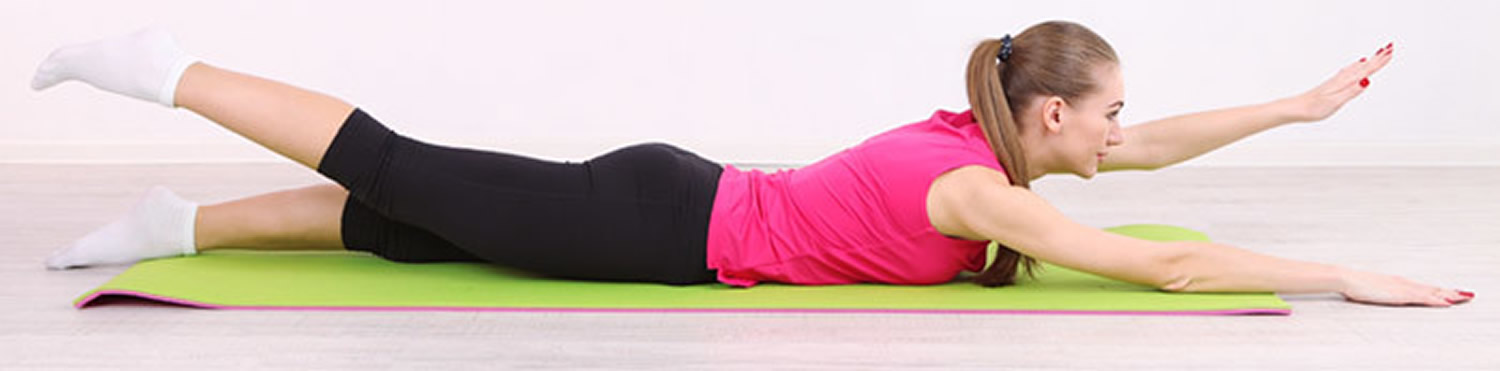
Lie down on your stomach with your face towards the ground and your palms facing the floor as though you’re about to do a push up. While keeping your pelvis firmly on the floor, gently push your upper body up from the ground. This should make your feel some stretch in your abs. Maintain this position for about 30 seconds before releasing.


9. Reclined Spinal Twist

Lie down, with your arms extended to the sides and placed on the floor. While keeping the right leg straight, pull up your left knee towards your chest, tilt it toward your right side, and then drop it slowly over your extended right leg.

Keep your shoulder blades flat on the ground, and you should feel the stretch around your back. Hold for about 30 seconds and repeat for the opposite side.


10. Figure 4 Stretch

Sit tall on the ground with both knees bent and both feet on the floor. Lift your right leg and cross it over your left thigh, while your left knee remains bent. Pull both legs inwards toward your abdomen for a deep stretch of your glutes. Hold this position for about 30 seconds, and repeat with the other leg.


11. Knees to Chest

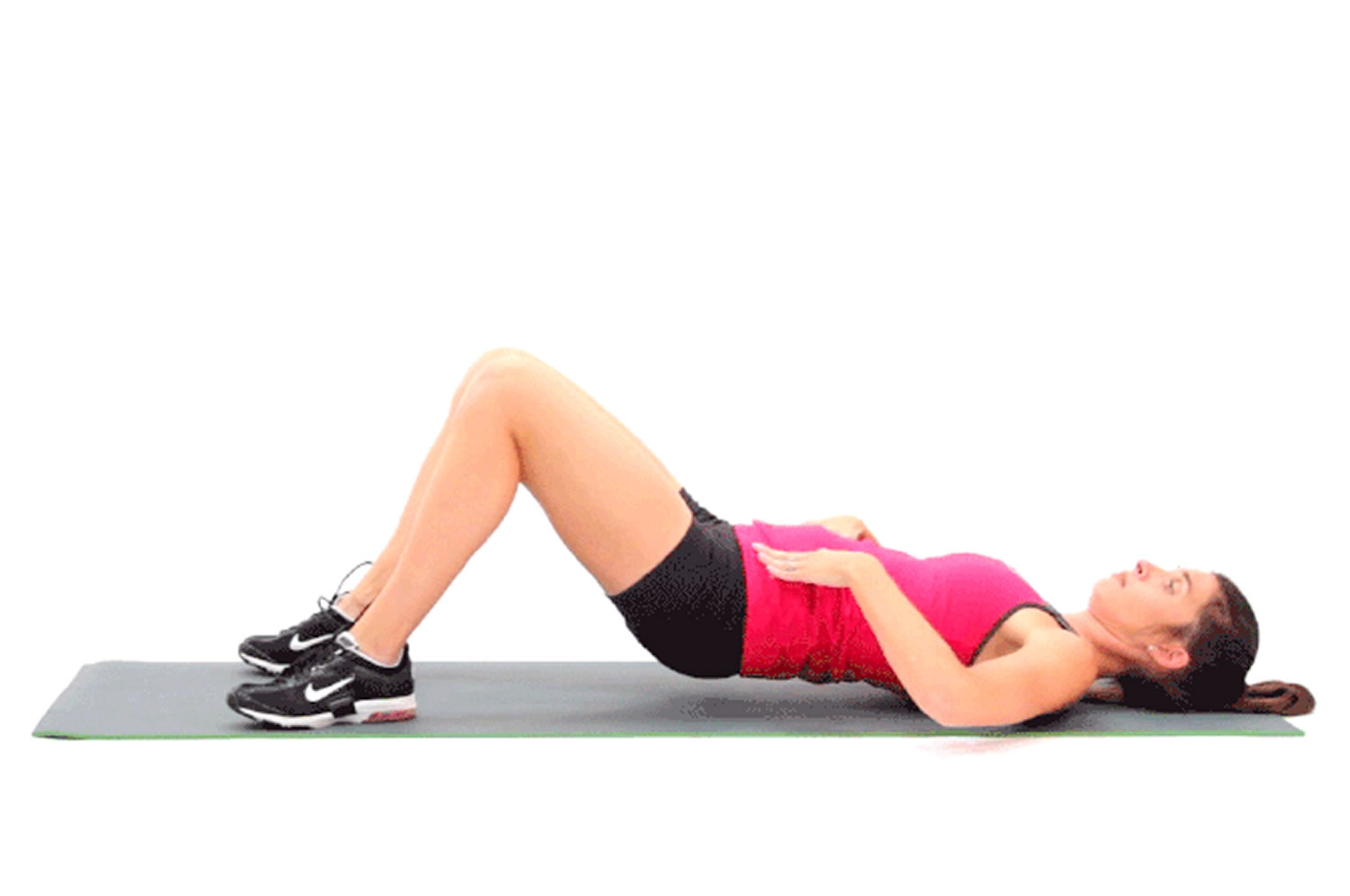
Lie on the ground facing the ceiling, with your knees bent. Hold your shins, and pull your knees toward your chest. This should make you feel some stretch in your lower back. Hold for about 30 seconds before releasing. If you're looking to loosen up your back muscles, this is one of the static stretches you can do daily.


12. Hip Flexor Static Stretch

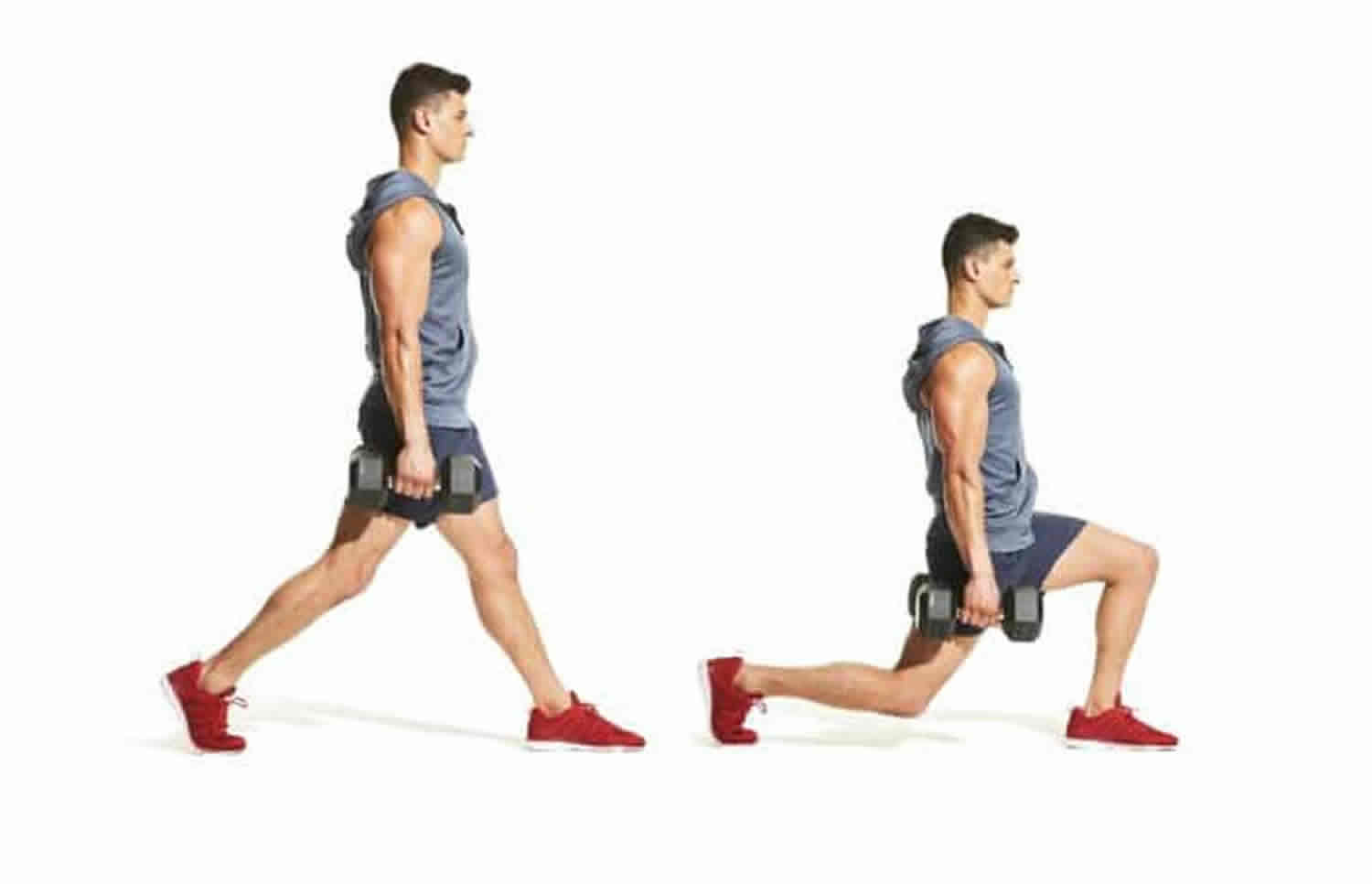
Stand upright in a standard lunge position, and place your two hands on your hips. Step out on your right foot into mini-lunge position, without your knee going beyond your right toe. Hold for about 30 seconds and repeat for the left side.


13. Standing Quad Stretch

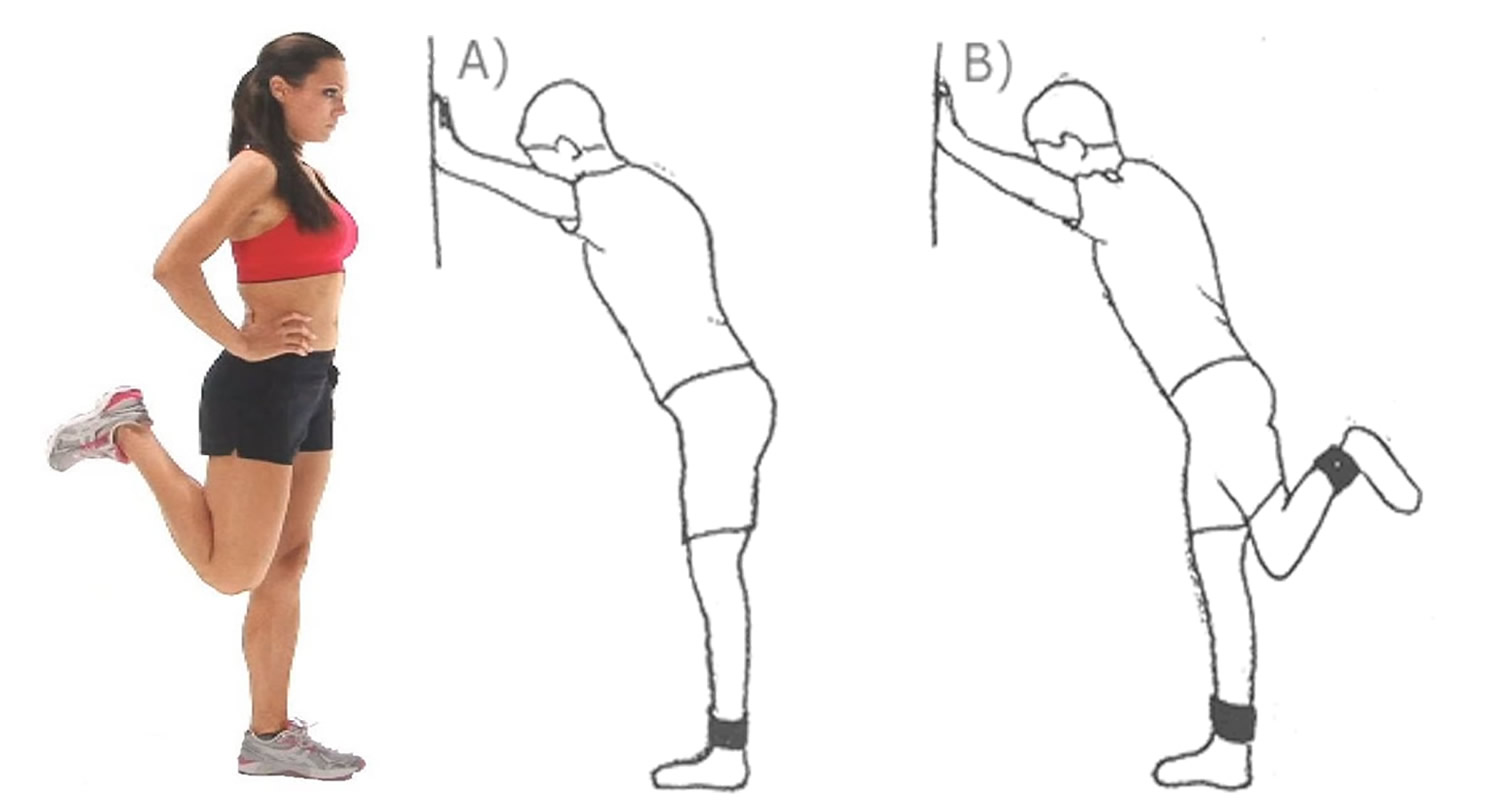
Stand tall while maintaining a straight posture. With your left hand, grab a pole, wall, or anything durable for balance. With your right hand, grab your right foot and pull up your heels until they touch your buttocks.

Keep your knees close together while doing this, push your hip forward, and you should feel the stretch in your quadriceps. Hold this position for about 30 seconds, and repeat for the other side. This is one of the best static stretches for the quads.


14. Hamstring Stretch

Sit on the floor with your right leg extended straight in front of you and your left leg bent. Reach forward with your right hand, and touch your right toes. This should cause a stretch in your right hamstring.

Hold this position for about 30 seconds, and repeat for the left leg. If you’re unable to reach your toes, try holding your shin instead, but seek to go further every time you perform the stretch until you can touch your toes. 


15. Calf Stretch

Sit on the ground and extend your right foot straight in front of you. Gently pull your right toes backwards with your right hand. This should cause a noticeable stretch in your calf.

Hold this position for about 30 seconds and repeat for the left leg, if you’re unable to reach your toes, use a rope or towel to pull your toes inward. 


When Should You Do Static Stretches?

Static stretching is great when done correctly and at the right time. Over the years, research has shown that static stretching produces best results when done after working out or on rest days,[6] but not as a part of warm up routines before an explosive workout session.

This is because static stretches have a cool-down effect on each muscle group and are more effective when done after the muscles are already warm.

That doesn't mean you must never ever perform static stretches before working out, but do it sparingly. Dynamic stretches, which involve more movement, are generally recommended for warming up as it helps the body prepare better for the work ahead. 


The Bottom Line

Carving out the body of your dreams isn’t only about lifting weights and running. You need to keep your body “elastic” if you’re going to make the most of your training, and that’s the whole point of static stretches.

Starting today, be sure to incorporate these static stretching exercises into your routine, and in no time, you’ll find yourself recovering faster and performing better than ever before.


References

  1. Brazilian Journal of Medical and Biological Research: Effect of frequency of static stretching on flexibility, hamstring tightness and electromyographic activity.
  2. International Journal in Sports Physical Therapy: CURRENT CONCEPTS IN MUSCLE STRETCHING FOR EXERCISE AND REHABILITATION
  3. Journal of Rehabilitation Medicine: Effect of stretching on hamstring muscle compliance.
  4. TrainingPeaks: The Benefits of Static Stretching Before and After Exercise
  5. Journal of Sport Rehabilitation: Effect of foam rolling and static stretching on passive hip-flexion range of motion.
  6. Scandinavian Journal of Medicine & Science in Sports: Does pre-exercise static stretching inhibit maximal muscular


12 Best Upper Body Exercises to Build Strength and Muscle Fast

12 Best Upper Body Exercises to Build Strength and Muscle Fast


12 Best Upper Body Exercises to Build Strength and Muscle Fast

Upper-body workouts are essential for building strength, improving posture, and creating a balanced physique. From classic bench presses to powerful barbell rows, the right exercises can help you gain muscle, boost endurance, and enhance overall performance in and out of the gym.


Whether you’re a beginner starting your fitness journey or an experienced lifter looking to upgrade your routine, choosing the best upper body exercises can make a huge difference in your results. That’s why we’ve put together this expert-backed list of the 12 best upper body exercises to help you build strength, increase muscle definition, and create effective grab-and-go workout routines for your next training session.


What You Need for the Upper Body Workout

Some of these exercises are moves you can perform at home with little to no equipment. However, your upper body consists of many different muscles, and you can’t hit them all with pull-ups and push-ups.

If you want to use the exercises in this list, you’ll probably need access to a commercial gym (or a very well-furnished home gym). The main pieces of equipment you should have are:

  • Barbell
  • Weight Plates
  • Dumbbells
  • Adjustable Weight Bench
  • Adjustable Cable Station
  • Squat or Power Rack
  •  


1. Overhead Press 

BarBend's Jake Herod performing the barbell overhead press.
Equipment NeededSquat or power rack, barbell, weight plates, wrist wraps (optional)
Muscles WorkedShoulders, triceps
Sets & Reps3-4 x 5-8

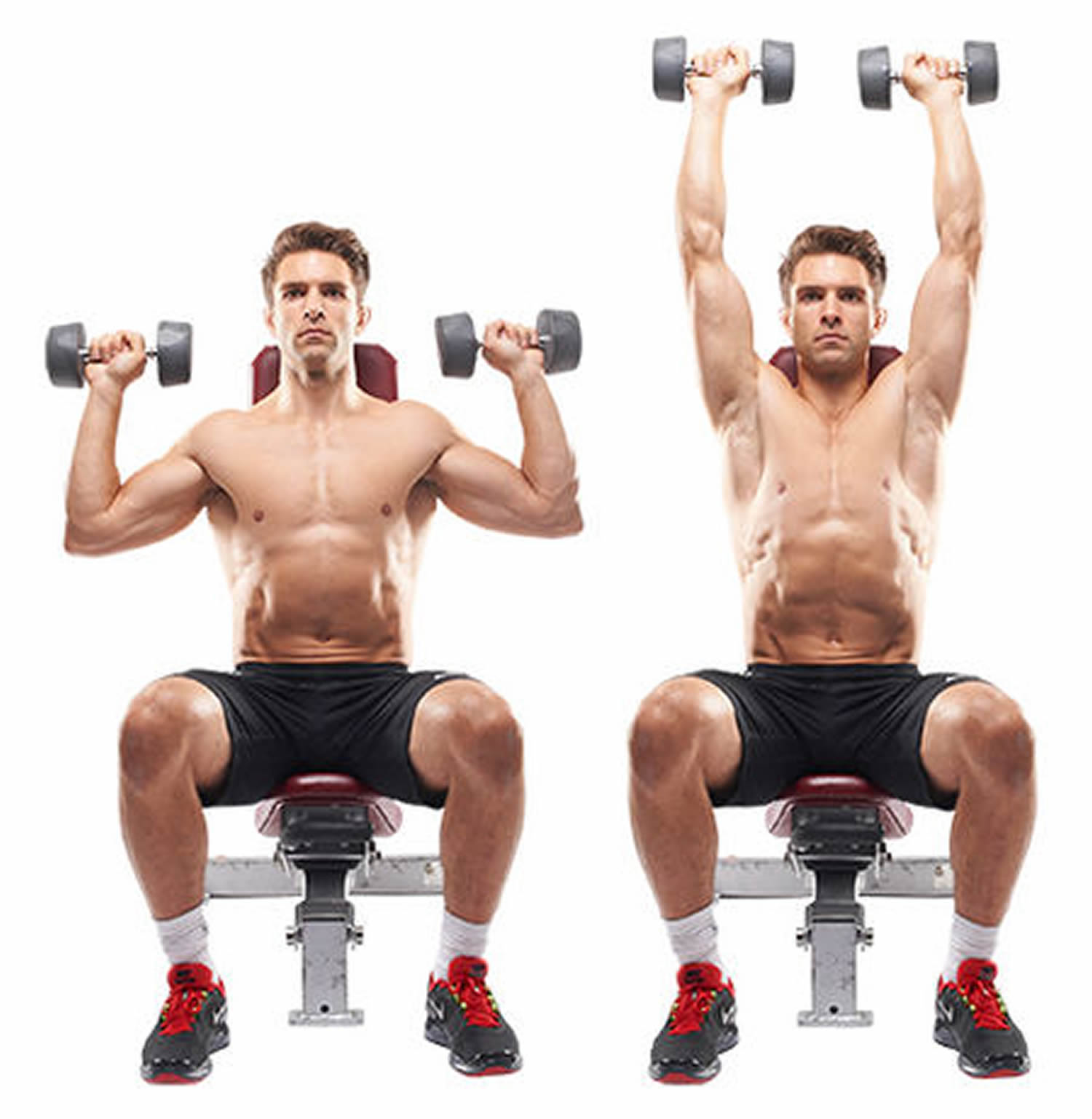
The strict press is one of the best shoulder exercises. We like it for its simplicity and functionality. If you can properly push a barbell over your head, you can do almost any other shoulder movement out there.

“Upper body strength movements, such as the bench press and overhead press, are essential for developing the pectoral, deltoid, and triceps muscles, contributing to overall upper body mass and power,” says BarBend Expert Gianna Masi.

You can use dumbbells, kettlebells, or a barbell for the strict press. Lifting a barbell does require more shoulder mobility, so if that’s something you’re lacking, start with dumbbells. 

How To Do It

  1. Set a barbell in the rack at shoulder height. With your hands shoulder-width apart, grab the bar from underneath, letting it sit in your palms, and set it at the top of your chest.
  2. Tighten your core and push your chest out to create a strong base. 
  3. Using only your upper body, move your chin out of the way and push the bar up in a straight line. 
  4. Lock your elbows out at the top of the lift and slowly lower back to the starting position.

Modifications

  • Make It Easier: Try an incline press instead.  For some people, a direct overhead press requires mobility their shoulders may not have, but you can derive most of (if not all) the same benefits from an incline press as an overhead press.
  • Make It Harder: Try a push press.  This is essentially an overhead press with a leg drive.  This allows slightly more weight while utilizing the coordination of the legs and core muscles to drive up into the bar..

Coach’s Tip: Warm up your rotator cuffs extensively before performing this lift.


2. Bench Press

BarBend's Jake Herod doing bench pressing a barbell in the Barbend gym.
Equipment NeededBench press station, barbell, weight plates, wrist wraps (optional)
Muscles WorkedChest, shoulders, triceps
Sets & Reps3-4 x 6-10

The bench press and all its variations (incline, decline, close-grip, with dumbbells, or the floor press) is a movement that targets the chest, triceps, and shoulders. It is one of the best movements to build horizontal pressing strength. 

Like most barbell exercises, it allows you to use a greater load than you could muster with kettlebells or dumbbells. Powerlifters should train the bench press routinely since it’s one of the three competition lifts alongside the squat and deadlift.

How To Do It

  1. Lie flat on your back on a bench and get your eyes directly underneath the barbell. 
  2. Grip the bar with your hands wider than shoulder-width apart. Bring your feet closer to your glutes, push your feet back, and unrack the bar so that it’s over your chest. 
  3. Lower the bar slowly to your chest as you breathe in and push your feet back. 
  4. Arch your back slightly to push the barbell up until lockout.

Modifications

  • Make It Easier: Try the floor press to limit your range of motion and add more stability.
  • Make It Harder: Pause with the bar on your chest for two seconds on every rep. 

Coach’s Tip: “Think about driving your body away from the bar and into the bench instead of reaching your arms up. This will help use the bench’s stability and keep you locked in throughout the movement,” Masi recommends.


3. Bent-Over Barbell Row

BarBend's Jake Herod performing the barbell row exercise.
Equipment NeededBarbell, weight plates, lifting straps (optional), lifting belt (optional)
Muscles WorkedLats, traps, lower back, biceps, core 
Sets & Reps3 x 6-12

The bent-over row is a popular exercise since it strengthens and increases mass in the upper back and lats. It allows you to use the most weight relative to other rowing variations. Lifting heavier weights regularly with good form equals more muscle. 

Because you’re in a hip hinge position, the bent-over row is the best lower back exercise that trains the lower back isometrically. A stronger lower back will help you brace and maintain a rigid torso when deadlifting and squatting. 

Variations To Try: Dumbbell row, seal row

How To Do It

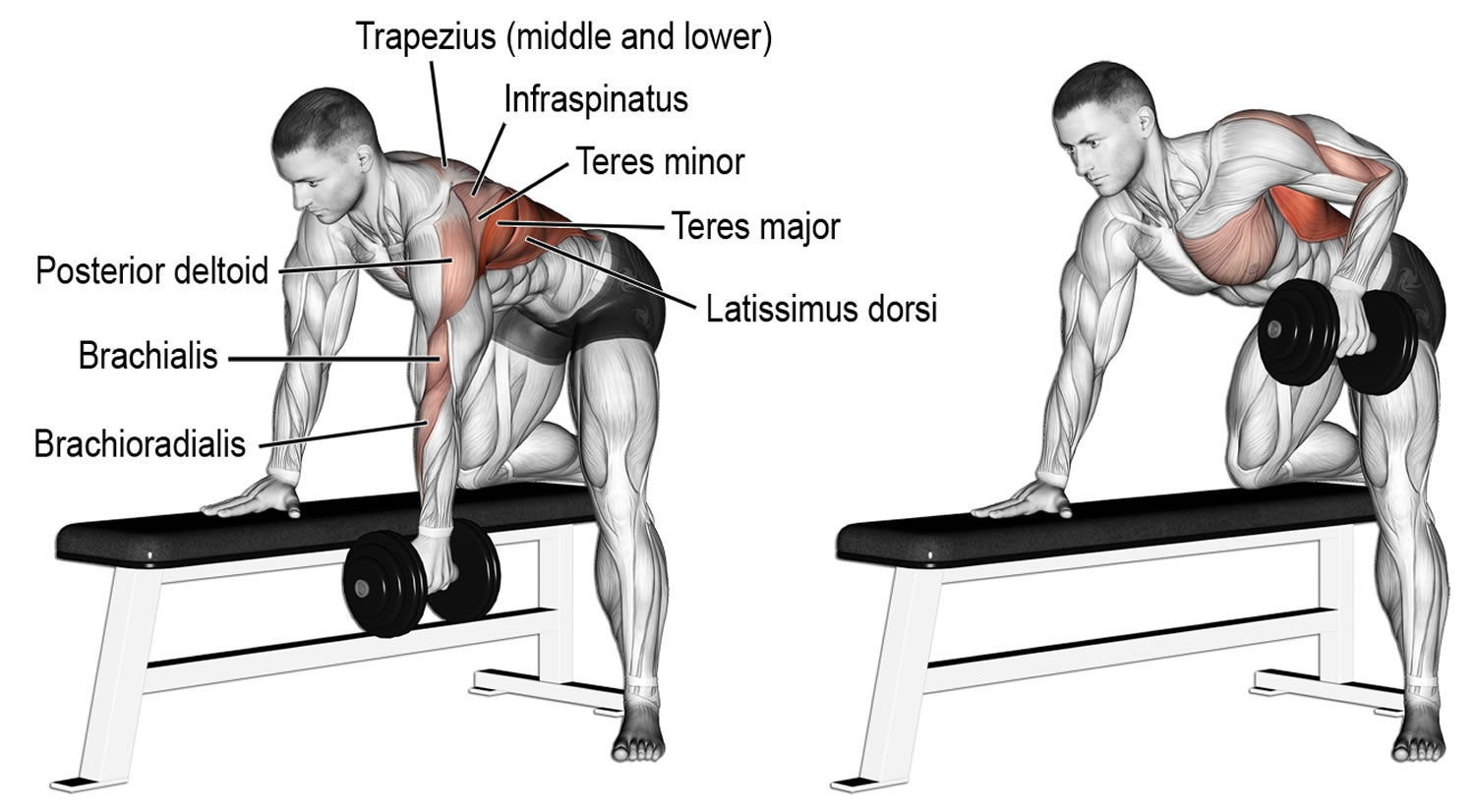
  1. Place a loaded barbell on the floor and stand with your feet slightly more than hip-width apart. 
  2. Hinge down to the barbell and grab the barbell with a shoulder-width grip. Then, bring the barbell up to knee level with the back straight and torso bent at 45 degrees. 
  3. Pull the barbell between your navel and sternum. 
  4. Pause, then slowly lower the barbell back down and repeat.

Modifications

  • Make It Easier: Lifting straps will allow you to practice your form without worrying about the bar slipping out of your hands. 
  • Make It Harder: Try pausing with the bar in contact with your stomach at the end of each rep. 

Coach’s Tip: If you feel like you need to compromise your back position to gain momentum to start your set, you’re lifting too heavy. Lower the weight.

4. Weighted Dip

BarBend's Jake Herod performing the weighted dip exercise.
Equipment NeededParallel bars, wrist wraps (optional), dip belt (optional)
Muscles WorkedTriceps, chest, shoulders
Sets & Reps3 x 8-12

Weighted dips allow you to simultaneously work your chest and triceps depending on the positioning of your body. Compared to most triceps exercises, the range of motion you achieve doing dips is longer, so it’s generally considered one of the best triceps exercises.


Suppose you can’t do weighted dips yet — no problem. Use your body weight until you build up your strength and endurance. Once you’re ready, add weight in small increments using a dipping belt. 

How To Do It

  1. Either use a weight belt, or weighted vest, or hold a dumbbell between the legs for resistance. 
  2. Squeeze the bars with each hand and lower yourself down until your elbows break 90 degrees. 
  3. Still squeezing the bars, drive yourself upwards while maintaining a slight forward lean.
  4. When approaching lockout, flex the back of your triceps, pause for a second, and slowly lower down and repeat.

Coach’s Tip: To target your chest more specifically, lean your torso forward.


5. Chin-Up

BarBend's Jake Herod doing a chin-up using a pull up bar.
Equipment NeededPull-up bar, dip belt (optional)
Muscles WorkedLats, biceps, upper back
Sets & Reps3-4 x 10+

The chin-up requires a lot of prerequisite strength, stability, and mobility — but perhaps less so than the pull-up. In this way, the chin-up may be more accessible to beginners. If you’re still new to the movement, use resistance bands to assist you.

And if you’ve already mastered the chin-up, keeping them actively in your repertoire will help ensure continued back and biceps strength. You can even add pauses at various spots in your range of motion to increase time under tension and kickstart even more muscle growth.

Variations To Try: Single-arm, band-assisted, or kipping

How To Do It

  1. Grab hold of a pull-up bar with your palms facing you, a little closer than shoulder-width apart.
  2. Hang from the bar until you’re stable. Initiating the pull with your back, drive your elbows down toward your back packets.
  3. Pull yourself up until your chin clears the bar. Lower with control and repeat for reps.

Modifications

  • Make It Easier: Do band-assisted or machine-assisted chin-ups if you can’t string together multiple unassisted reps.
  • Make It Harder: Add weight by holding a dumbbell between your ankles or wearing a dip belt with plates attached. 

Coach’s Tip: Keep your core engaged and in a hollow hold position. This will ensure that your whole body is working and that the move is as efficient as possible.

6. Push-Up

BarBend's Jake Herod doing the standard push-up.
Equipment NeededExercise mat (optional)
Muscles WorkedChest, shoulders, triceps
Sets & Reps2-3 x 10-20

Ah, the push-up. It’s one of the best chest exercises, yet so many people struggle with push-ups or discard them altogether. But when done with good form and a full range of motion, this compound exercise activates multiple muscles in your upper body, such as your chest, shoulders, triceps, and abdominals. 

Push-ups are a quick and effective way to build strength and require nothing but your body weight. (Though, you can add a weight vest or weight plate to make the movement more challenging.)

How To Do It

  1. Start in a plank position with your hands stacked underneath your shoulders, your back flat, and your core tight. 
  2. Maintaining a straight line from your head to your heels, slowly lower your body to the floor by bending your elbows. Go as close to the ground as you can without losing tension.
  3. Press the floor away from your hands while maintaining a tight core to avoid dipping hips. Finish in the position you started in.

Modifications

  • Make It Easier: You can do push-ups on your knees or perform incline push-ups to make the movement easier.
  • Make It Harder: Try decline push-ups or bring your hands into a diamond position. 

Coach’s Tip: If your chest or stomach prevents you from reaching a full range of motion, you can place your hands on low steps, dumbbells, or push-up bars to give your body the room you need.


7. Lat Pulldown

BarBend's Jake Herod performing the lat pulldown exercise.
Equipment NeededLat pulldown station, lifting straps (optional)
Muscles WorkedLats, upper back, biceps
Sets & Reps2-3 x 10-15 

If you’re looking to target the largest muscle in your back, we suggest the lat pulldown. This exercise allows for heavier weights and more reps because your body will generally be stabilized by the machine, making it one of the best upper body pull exercises you can do.

Variations To Try: Close-grip, single-arm

How To Do It

  1. Sit straddling the bench facing the lat pulldown machine, or tuck your thighs underneath the pad if you have access to one. 
  2. Pull your shoulders away from your ears and use your back to pull the bar down to your upper chest. A slight lean back is okay if needed. 
  3. Slowly extend the arms to your starting position.

Coach’s Tip: Vary your grip using different handles or grip widths of the lat pulldown bar to alter the exercise angle.


8. Inverted Row

BarBend's Jake Herod performing an inverted row with a barbell set in a power rack.
Equipment NeededBarbell, squat rack, or stable horizontal bar 
Muscles WorkedLats, biceps, upper back, core, glutes
Sets & Reps2-3 x 10+

Secret’s out; we adore the lat pulldown. This exercise does not get as much recognition as it should — mainly because it’s seen as a “Pull-Up Lite” — but it can benefit anyone from beginners to experienced athletes if you know how to use it. 

Although underrated, there are plenty of benefits to the inverted row — it’s scalable, can be done almost anywhere, and taxes the back muscles without loading the lower back. 

How To Do It

  1. Set a barbell at waist height in a power rack
  2. Get under the bar and grip it slightly wider shoulder-width apart with your palms facing away from your head. 
  3. Extend your arms and extend your legs, so your body is in a straight line from your head to your heels. 
  4. Keeping that straight line, pull your body up to the bar until your chest reaches it, then slowly lower back to your starting position. 

Modifications

  • Make It Easier: Set the bar up a bit higher so your body is at a steeper incline.
  • Make It Harder: Balance a weight plate across your lap to add resistance. 

Coach’s Tip: Think about pulling the bar toward your body, not yanking yourself up to the bar. 


9. Overhead Triceps Extension

BarBend's Jake Herod performing the cable overhead triceps extension.
Equipment NeededAdjustable cable station, attachment of choice
Muscles WorkedTriceps
Sets & Reps2 x 12-15 

If you want bigger arms, we have a pro tip — the triceps make up roughly two-thirds of your upper arm compared to your biceps. They steal the gun show more than you think. 


“Placing the triceps overhead will put them into a fully stretched position, which will help maximize stimulating strength and hypertrophy even further then a traditional tricep extension,” Masi says. “Plus, this will be a great stretch on the shoulder joint, assisting with the overhead position.”

Variations To Try: Single-arm, underhand

How To Do It

  1. Place a dumbbell in a diamond grip (make a diamond with your hands and place the bottom of the weight plate in between) and hold it overhead with your arms fully extended. 
  2. Tighten your core, relax your shoulders, and keep your elbows tight to your head as you begin to bend your arms. Stop bending when your arms have made a 90-degree angle.
  3. Press back up to your starting position.

Modifications

  • Make It Easier: Most people tend to find a single-hand rope attachment more comfortable to use than a straight or cambered bar.
  • Make It Harder: Try pausing in the stretched position on each repetition. 

Coach’s Tip: You can perform this exercise seated or standing. Either way, keep your core steady.


10. Landmine Press

BarBend's Jake Herod performing the landmine press exercise.
Equipment NeededLandmine attachment, barbell, weight plates 
Muscles WorkedTriceps, shoulders, core
Sets & Reps2 x 12-15

The landmine press is less intense than the standard shoulder press or overhead press since it does not require as much shoulder flexion (due to the angled pressing path). 


However, that doesn’t make this exercise any easier, and it’s a great way to target your upper body without lifting too heavy.

How To Do It

  1. Set up a barbell in a landmine base or, if you don’t have one, the corner of a wall. If performing the movement with one arm, grab the barbell at the top with one hand and hold it on the side you’re pressing from. If performing the move with both hands, grip the barbell and hold it in the middle of your chest. 
  2. Press the barbell straight forward until your arm(s) are fully extended. 
  3. Slowly lower the bar back to your starting position.

Modifications

  • Make It Easier: You can do this move in a full or half-kneeling position instead of standing up. 
  • Make It Harder: Try this exercise with a narrow staggered stance to challenge your balance.

Coach’s Tip: Adjust your foot position as needed until you find the proper angle where you feel your entire shoulder girdle engaging.

11. Farmer’s Carry

BarBend's Jake Herod doing the fireman's carry with dumbbells in the gym.
Equipment NeededDumbbells, kettlebells, or trap bar frame
Muscles WorkedTraps, upper back, lower back, core 
Sets & Reps2 x 30 seconds 

Heavy carries are a great way to build a bigger and more durable upper body. Gripping a heavy object taxes the muscles in the upper back, traps, and forearms, making this upper-body exercise with dumbbells a strength-boosting move that also bolsters your endurance. 

“Make sure to actually load these!  Most people in the gym are using grocery bag type loads.  We are trying to push well past that with these,” Masi notes. “Legendary strength and conditioning coach Dan John has certain standards for these — half your body weight in each hand for 20-40 meters. If you’re really a beast he says you should be able to do that same distance with bodyweight in each hand.”

How To Do It

  1. Grab a pair of heavy dumbbells from the rack, grip them tightly, and stand tall by keeping your shoulders down and chest up. 
  2. Walk slowly and deliberately in a straight line, placing one foot in front of the other for the required distance, and then set the weight down carefully.

Coach’s Tip: Keep your shoulders back and down throughout the exercise to maintain back engagement.

12. Bicep Curls



BarBend's Jake Herod performing the dumbbell biceps curl.
Equipment NeededDumbbells or barbell
Muscles WorkedBiceps
Sets & Reps3 x 8-12

We love biceps just as much as you do — this isolation exercise is, basically, the only way to zero in on your biceps without involving other supporting muscles, making it one of the best biceps exercises. There are dozens of biceps curl variations out there, and they all accomplish mostly the same thing. If you’re new to curls, we think bicep curls are a phenomenal upper body exercise with dumbbells

Variations To Try: Cheat curl, reverse curl, incline dumbbell curl, Zottman curl

How To Do It

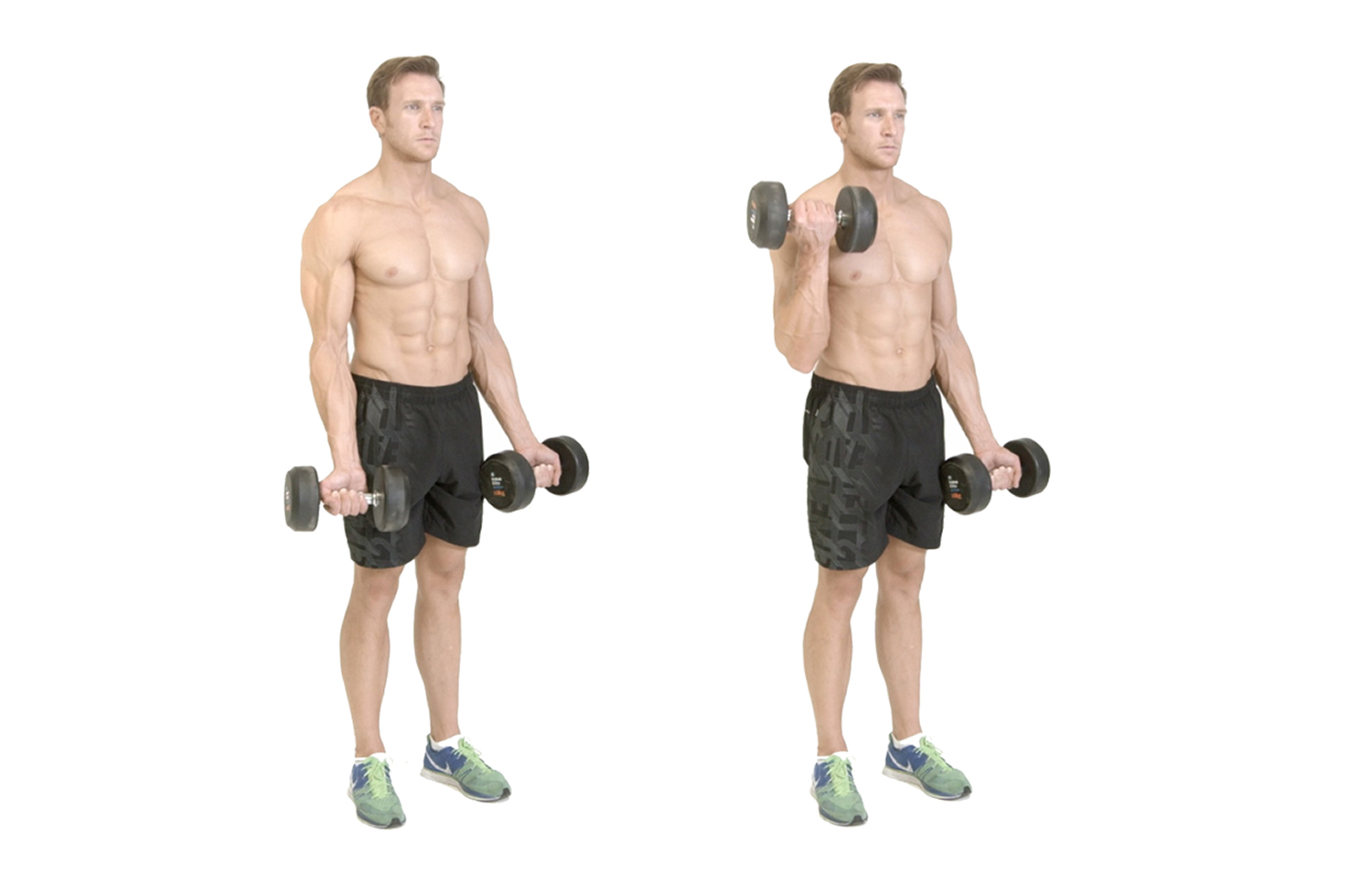
  1. Stand upright while holding a dumbbell in each hand.
  2. Rotate your arms so your palms are pointed forward.
  3. Without moving your upper arms, bend at the elbows and curl the weights up until your forearm is at least parallel to the floor.

Coach’s Tip: Take care to avoid swaying from side to side as you curl. If you’re using a barbell, limit any swaying or thrusting from your hips. 

5 Upper Body Workouts to Incorporate

The best upper body workouts are the ones that integrate push and pull movements to keep your body balanced in terms of both strength and muscle growth. Here are some of the upper body workouts you can incorporate into your overall program, depending on your specific fitness goals and aspects of your identity.

Upper Body Warm-Up

All good workouts start with an appropriate warm-up. Even the best upper body workout out there may not go according to plan if you don’t prepare properly. For most people, the shoulders require a bit of attention and priming before you dive into heavy lifting. Try this shoulder-focused warm-up routine:

  • Cardio: Do 5 to 10 minutes on the treadmill, elliptical, bicycle, or stair stepper to get your heart rate up.
  • Shoulder Dislocations: Grab a PVC pipe or dowel and hold it overhead with a wide grip, then slowly swing the object forward and backward in an arc around your torso.
  • Face Pulls: Grab a cable station or resistance band and perform 15-20 face pulls, driving your elbows high and behind your torso to engage your upper back.
  • Scapular Push-Ups: Assume a push-up position, but instead of bending your elbows, lift and lower your torso a few inches by pushing solely with your shoulders and allowing them to move.

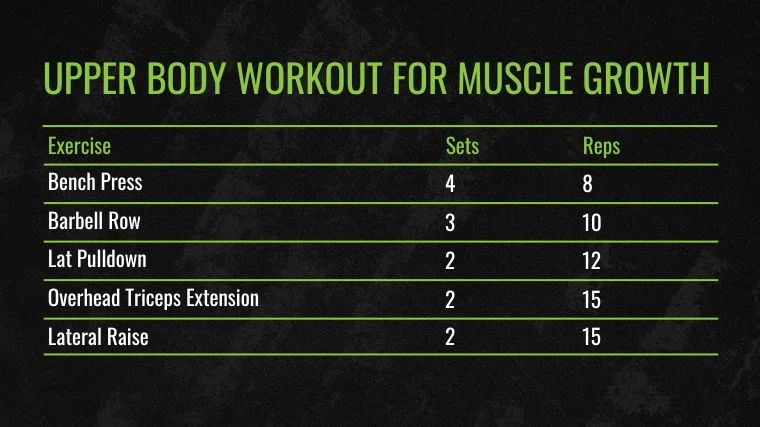
Upper Body Workout for Muscle Growth

Building muscle is all about using the tools at your disposal — we mean your exercises of choice — to create as much muscle fatigue and strain as possible. To that end, we’re prioritizing exercises that have simple, stable techniques. We also want to target all major muscle groups in your upper body as efficiently as possible. 

The Upper Body Workout for Muscle Growth chart.


  • Bench Press: 4 x 8
  • Barbell Row: 3 x 10 
  • Lat Pulldown: 2 x 12
  • Overhead Triceps Extension: 2 x 15
  • Lateral Raise: 2 x 15 

Upper Body Workout for Strength

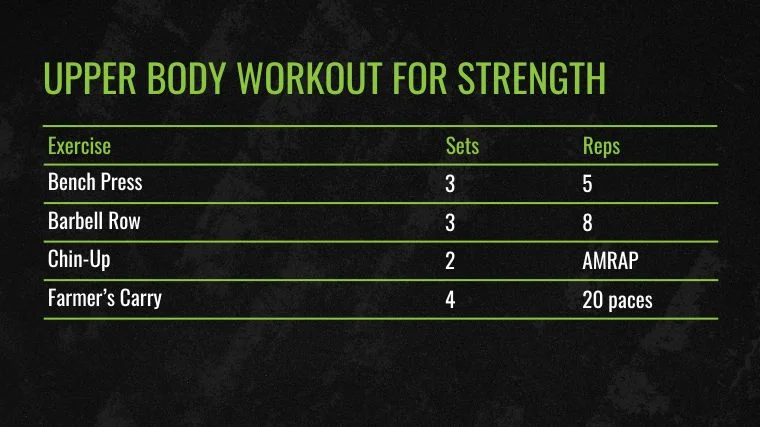
To get strong, you need to focus on performing fewer reps with more weight, one exercise at a time. This low-rep, heavy-weight style of training forces muscles to exert maximal force, recruiting the more explosive type II muscle fibers needed to lift heavier weights. 

Perform this workout once per week. Be sure to get a lot of rest between sessions — this is a taxing training session. Perform all the sets for each movement before moving onto the next exercise. Also, do not cut your rest time short. Rest three to five minutes between sets for most of these.

The Upper Body Workout for Strength chart.
  • Bench Press: 3 x 5 
  • Barbell Row: 3 x 8
  • Chin-Up: 2 x AMRAP 
  • Farmer’s Carry: 4 x 20 paces 

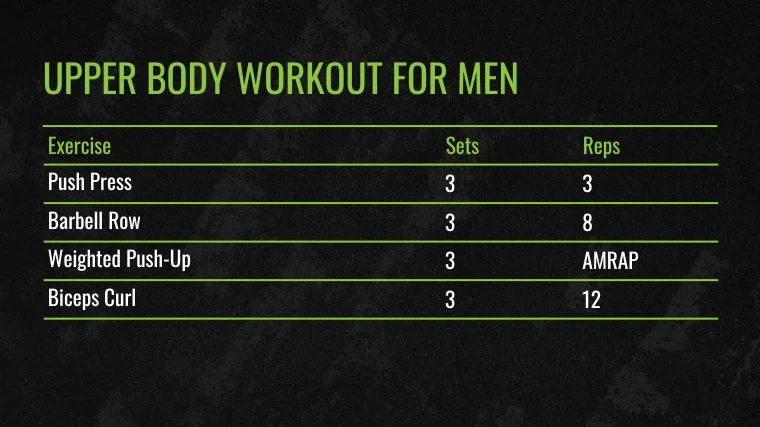
Upper Body Workout for Men 

People of all genders can follow the same workout routines. That said, cis men may have a higher ratio of Type-II, fast-twitch muscle fibers. (1) To play to your strengths and beef up your pecs, shoulders, and arms in the process, give this one a go: 

The Upper Body Workout for Men chart.

[Read More: Get Freakishly Strong With the 5×5 Workout Program]

  • Push Press: 3 x 3 
  • Barbell Row: 3 x 8
  • Weighted Push-Up: 3 x AMRAP 
  • Biceps Curl: 3 x 12 

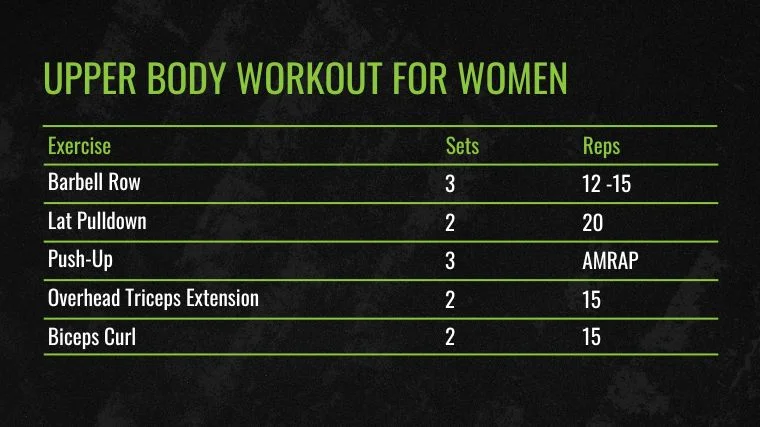
Upper Body Workout for Women

Women can perform the same strength training workouts as anyone else. That said, some studies have shown that female athletes respond slightly better to higher-repetition training. (2) We can modify a standard upper body workout to emphasize those advantages. Here’s an example: 

The Upper Body Workout for Women chart.
  • Barbell Row: 3 x 12-15
  • Lat Pulldown: 2 x 20 
  • Push-Up: 3 x AMRAP
  • Overhead Triceps Extension: 2 x 15
  • Biceps Curl: 2 x 15 

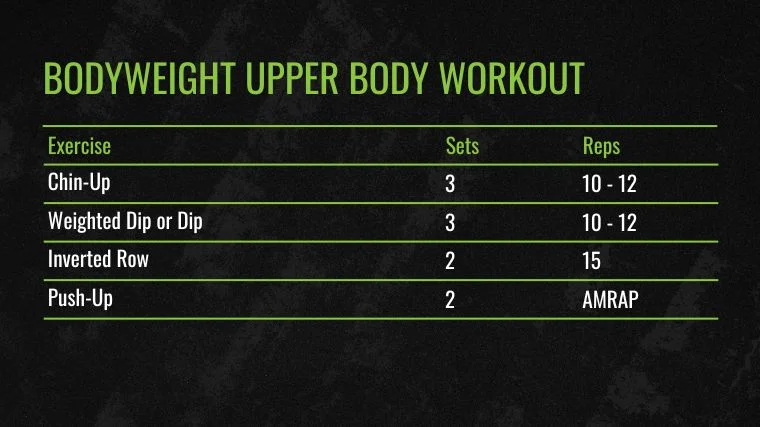
Bodyweight Upper Body Workout

You don’t need weights to see results (though owning dumbbells, kettlebells, weight plates, a weight bench, and a barbell doesn’t hurt). Your body weight is a useful tool for combating gravity to produce muscle- and strength-building tension. Workouts without weights are also inherently more joint-friendly since there’s no external load pressing down on your spine, knees, and/or elbows. 

The Bodyweight Upper Body Workout chart for the best upper-body exercises.
  • Chin-Up: 3 x 10-12 
  • Weighted Dip or Dip: 3 x 10-12
  • Inverted Row: 2 x 15
  • Push-Up: 2 x AMRAP 

Benefits of Training Your Upper Body

Aside from getting the V-taper, there are plenty of benefits to training your upper body. When you are pushing, pulling, or hinging with weights or just your body weight, exercises help you perform tasks in your daily life. They improve mobility and flexibility, which can help to reduce your risk of injury. 

Reduced Risk of Injury 

With a stronger upper body comes more stability. Every day you are most likely pushing and pulling moderate to heavy objects, whether opening a door or moving furniture. Maintaining muscle mass is especially important as you age because you lose muscle as you get older. 

Research suggests that muscle mass decreases about three to eight percent per decade after you pass 30 years old, so it’s important to continue to load your muscles. (3)

Improve Other Areas of Training 

A strong upper body is not only important for better shoulder presses but is also beneficial in other areas such as squats or deadlifts. Pulling a heavy barbell when deadlifting activates your biceps and back muscles. 

The stronger these muscles, the more weight you can lift. When squatting, the core muscles are engaged, and the stronger these are, the more you can lift properly, and manage the risk of injury

Build a Strong Upper Body

It’s not just about developing other areas of your training life. By developing a strong, powerful upper body, you’ll be able to become more competitive at any strength sport. Whether you’re trying to develop an X-frame for your next bodybuilding show or boost your Total in weightlifting, you’ll need to train your upper body extensively to make it happen.

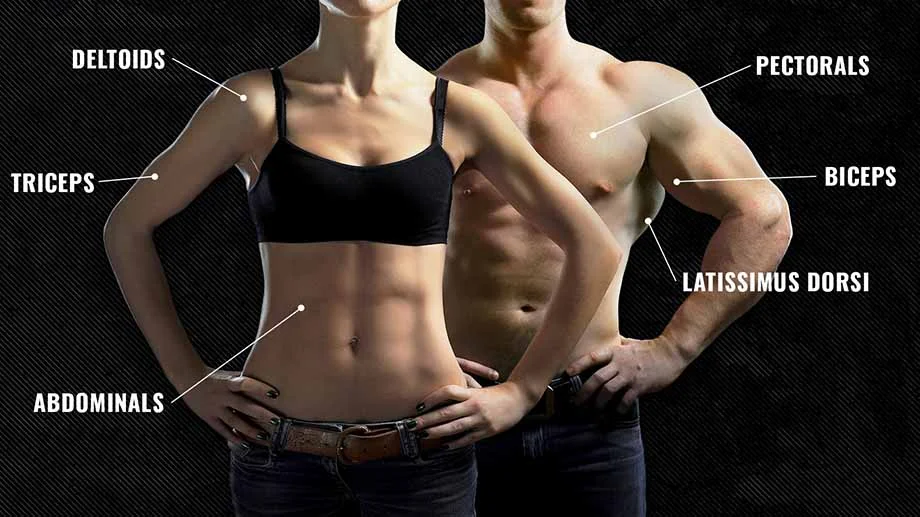
Muscles of the Upper Body

Below are some of the larger muscle groups of the upper body targeted and trained by these upper body mass-building exercises. 

A photo of the anatomy of the upper body, labeled with the muscles worked during upper-body exercises.
Credit: Valeriy Lebedev / Shutterstock

Latissimus Dorsi (Back)

The latissimus dorsi, also known as the lats, is a large muscle group that runs across the entire posterior of the torso. The back is the key to lifting heavier, gaining size, and improving performance.


Along with the chest muscles, these muscles help posture and spine stability.

Pectorals (Chest)

The pectoral muscles (pectoralis major and minor) are developed by most horizontal pressing movements like the bench press (and the wide array of variations), push-ups, and dips. It’s important to keep these muscles strong because it helps with overall upper body strength and, along with the back muscles, helps prevent bad posture. 

Deltoids (Shoulders)

The shoulder area comprises the deltoids and posterior shoulder complex/stabilizers (trapezius, scapular shoulder blades, and rhomboids). Vertical pressing movements like push presses and shoulder press variations are great movements for shoulder hypertrophy. 

Triceps

The triceps are a smaller muscle group than the back and chest and serve an important role in aiding in pressing movements. They are also more responsible for arm mass.

Biceps

The biceps run along the anterior part of the arm and are responsible for elbow flexion and aiding in pulling movements like rows, pull-ups, carries, and deadlifts.

More Upper Body Training Tips

Now that you have a handle on the best upper body exercises to strengthen your chest, triceps, shoulders, back, and biceps, you can also check out these other helpful training articles for strength, power, and fitness athletes.

Frequently Asked Questions

How often should I train the upper body?

Your upper body is a collection of many different muscles that work together. As such, you’re likely to experience a lot of fatigue if you try to train your upper body too often. Aim for two upper body workouts per week.

What is the best upper body workout routine?

A well-designed upper body workout will contain both “push” and “pull” exercises, and also incorporate a variety of different equipment to challenge your body in unique ways. 

References

  1. Oranchuk DJ, Storey AG, Nelson AR, Cronin JB. Isometric training and long-term adaptations: Effects of muscle length, intensity, and intent: A systematic review. Scand J Med Sci Sports. 2019 Apr;29(4):484-503.
  2. Nuckols, G. (2023a, July 31). Sex differences in training and metabolism. Stronger by Science. 
  3. Fujita, Satoshi, Nazemi, Reza, & Volpi, Elena. Muscle Tissue Changes with Aging (2004). PubMed. 7(4)


Pilates 101: Everything Beginners Need to Know Before Starting

Pilates 101: Everything Beginners Need to Know Before Starting

Pilates 101: Everything Beginners Need to Know Before Starting


Why Pilates Continues to Dominate the Fitness World

Over the past few years, Pilates has evolved from a niche practice into one of the most popular fitness methods worldwide. Once closely associated with dancers and rehabilitation programs, it is now a mainstream workout embraced by people of all ages and fitness levels.

Recent fitness trend reports consistently rank Pilates among the most in-demand workouts globally. Its appeal isn’t just a passing trend—it reflects a shift in how people approach fitness: smarter, more mindful, and focused on long-term results rather than quick intensity.

So, what makes Pilates stand out?

  • It delivers noticeable results without high-impact strain or heavy lifting
  • It’s beginner-friendly, allowing anyone to start and progress at their own pace
  • It emphasizes controlled, high-quality movement over repetitive intensity
  • It builds strength, flexibility, and body awareness all at once

In a world where many workouts push “more is better,” Pilates offers a refreshing alternative: precision over pressure, and consistency over extremes. That’s exactly why it continues to grow in popularity year after year.


The Core Principles of Pilates

What distinguishes Pilates from many other fitness methods isn’t just the exercises themselves, it’s the principles that govern how every exercise is performed. Understanding these principles before your first class will dramatically improve how quickly you progress.

  1. Concentration

Every Pilates exercise demands your full mental attention. This isn’t a workout you can do while watching TV or zoning out. You’re constantly asking: am I using the right muscles? Is my spine in neutral alignment? Am I breathing correctly?

the benefit of pilates training

  1. Control

No movement in Pilates is performed carelessly or with momentum. Every phase of every exercise — the effort and the return — is controlled deliberately. This is what makes Pilates simultaneously gentle and challenging.

  1. Centering

All movement in Pilates originates from or passes through the center — the powerhouse. Before any limb moves, the core is engaged. This principle is why Pilates is so effective for people recovering from back pain, and why it builds functional strength that transfers directly to everyday movement.

  1. Breath

Breathing in Pilates is specific and deliberate. Generally, you exhale on the effort and inhale on the release. Proper breathing activates the deep abdominal muscles and keeps the nervous system regulated throughout the workout.

  1. Flow

Pilates is not a series of isolated exercises — it’s a flowing sequence where movements transition smoothly from one to the next. This flow quality keeps the workout dynamic and continuous rather than stop-start.

  1. Precision

One perfectly executed Pilates exercise is worth ten sloppy repetitions. The emphasis on precision is what makes Pilates so different from gym-based training, where more sets and reps are often seen as better. In Pilates, the quality of movement is everything.

pilates training

Mat Pilates vs. Reformer Pilates: Which Should You Start With?

Start with mat Pilates if:

  • You want to begin at home with minimal investment
  • You’re completely new to exercise and want to learn the foundational principles before adding equipment
  • Budget is a consideration — mat classes are significantly cheaper
  • You want to practice on your own schedule

Start with reformer Pilates if:

  • You’re recovering from injury — the reformer’s spring support can help you move safely through a greater range of motion
  • You have access to a studio and want structured guidance from a qualified instructor
  • You’re already somewhat active and want more variety and challenge from the beginning
  • You’re motivated by the social environment of a studio

The honest advice? If you have access to a reformer studio, try it. If you don’t, mat Pilates is a complete and fully effective practice on its own.

strength pilates training

What to Expect in Your First Pilates Class

First-class anxiety is real with Pilates — partly because the movements look deceptively simple from the outside. Here’s what first-timers consistently report:

You will be surprised by how hard it is. Pilates movements are small, controlled, and precise — which means your stabilizing muscles, which are often chronically underused, get worked in ways they’re not accustomed to. Expect muscle fatigue in places you’ve never noticed before.

The instructor will correct your form. This is a good thing. Pilates corrections are specific and helpful — they’re not a sign you’re doing badly; they’re what makes the practice effective.

You will not be great at it immediately. That’s the point. Pilates has a learning curve because it requires building body awareness before you can fully execute the movements. Be patient with yourself in the first few sessions.

Almost universally, first-time Pilates students report the same thing after class: ‘I didn’t expect to sweat, and I definitely didn’t expect my abs to feel like that.’ Give it three sessions before forming a final judgment.

Common Pilates Moves for Beginners

These exercises form the foundation of most beginner Pilates sequences. Learning them well before your first class will give you a significant head start.

The Hundred

The signature Pilates warm-up. Lie on your back, lift your legs to a 45-degree angle, raise your head and shoulders, and pump your arms vigorously in small, controlled beats — ten beats per breath, for a total of one hundred. It warms the body, activates the core, and establishes the breathing pattern for the rest of the session.

how looks like a pilates training

The Roll-Up

A controlled spinal flexion movement. Lie flat, arms overhead, and slowly roll up to sitting — one vertebra at a time — before slowly rolling back down. This exercise requires — and builds — significant spinal mobility and abdominal strength.

Single Leg Stretch

Lying on your back with head and shoulders raised, draw one knee into your chest while extending the other leg. Switch in a controlled, flowing rhythm. This exercise works the deep abdominals while coordinating breathing and limb movement.

The Plank

A full-body stabilization hold that builds shoulder, core, and back strength simultaneously. In Pilates, the plank is performed with heightened attention to the subtle engagement of the powerhouse — it’s more active than a standard plank even though it looks the same.

Spine Twist

Sitting tall with legs extended and arms out to the sides, rotate your spine to each side with deliberate precision. This exercise develops spinal rotation mobility and teaches you to move from your center rather than your shoulders.

pilates supplement

How Often Should Beginners Practice?

Joseph Pilates himself famously said: ‘In ten sessions, you’ll feel the difference. In twenty, you’ll see the difference. And in thirty, you’ll have a whole new body.’

  • Two to three sessions per week is the ideal range for beginners — enough to build neuromuscular patterns without overloading muscles that are adapting to new demands
  • Each session can range from 30 to 60 minutes. A focused 30-minute mat session delivers significant benefit
  • Consistency matters more than frequency. Three sessions per week for eight weeks is dramatically more valuable than six sessions per week for two weeks then nothing
  • Rest days are important — the adaptations that build strength happen during recovery, not during the workout itself

What You’ll Notice After 30 Days

Most people who practice Pilates three times a week for thirty days report a specific cluster of changes — changes that are consistent enough to have become almost clichéd in the Pilates community. Yet they keep proving true for new students.

  • Your posture changes noticeably — and people around you notice before you do
  • Lower back pain, if present, often reduces significantly or disappears entirely
  • You stand taller without consciously trying to
  • You become aware of how you use your body in daily life — how you sit, how you lift, how you walk
  • Your core feels fundamentally different — stronger and more activated even when you’re not working out
  • You sleep better — Pilates activates the parasympathetic nervous system and reduces cortisol
  • Flexibility improves, particularly in the spine and hips, often dramatically

pilates class

Equipment and What You Actually Need

Essential for home practice:

  • A good quality exercise mat — slightly thicker than a yoga mat (around 6mm) is ideal for cushioning the spine
  • Comfortable, form-fitting clothing — you need to see your alignment, and instructors need to see yours

Helpful but optional:

Not necessary to start:

  • A reformer machine — they typically cost between $2,000 and $7,000. Studio access is the realistic option for most people
  • Pilates socks — helpful in studio settings but irrelevant for home practice

a pilates studio

Finding the Right Class or Instructor

The quality of your instructor matters enormously in Pilates — far more than in many other fitness modalities. Because the practice is so technique-focused, a knowledgeable teacher who can give you precise corrections will accelerate your progress dramatically.

What should you look for?

  • A certification from a recognized Pilates organization (BASI, STOTT, Peak Pilates, Balanced Body) rather than a weekend workshop
  • Experience teaching beginners specifically — not all good Pilates instructors are equally good at breaking down fundamentals
  • Clear cueing — can they explain not just what to do, but why you’re doing it and what you should feel?

For online practice, platforms like Pilates Anytime, Move with Nicole, and Sydney Cummings Houdyshell offer excellent beginner programs that have helped millions of people start a home practice with proper foundations.

Conclusion

Pilates has dominated the fitness world for three consecutive years not because of clever marketing — but because it delivers on its promises in ways that people feel almost immediately.


Top 7 Workout Routines For Building Muscle

Top 7 Workout Routines For Building Muscle

Top 7 Workout Routines For Building Muscle


Building muscle isn’t just about lifting heavy weights—it’s about choosing the right exercises and performing them consistently with proper form. Whether you’re working out at the gym or at home, these seven workout routines can help you develop strength, improve muscle definition, and reach your fitness goals faster.


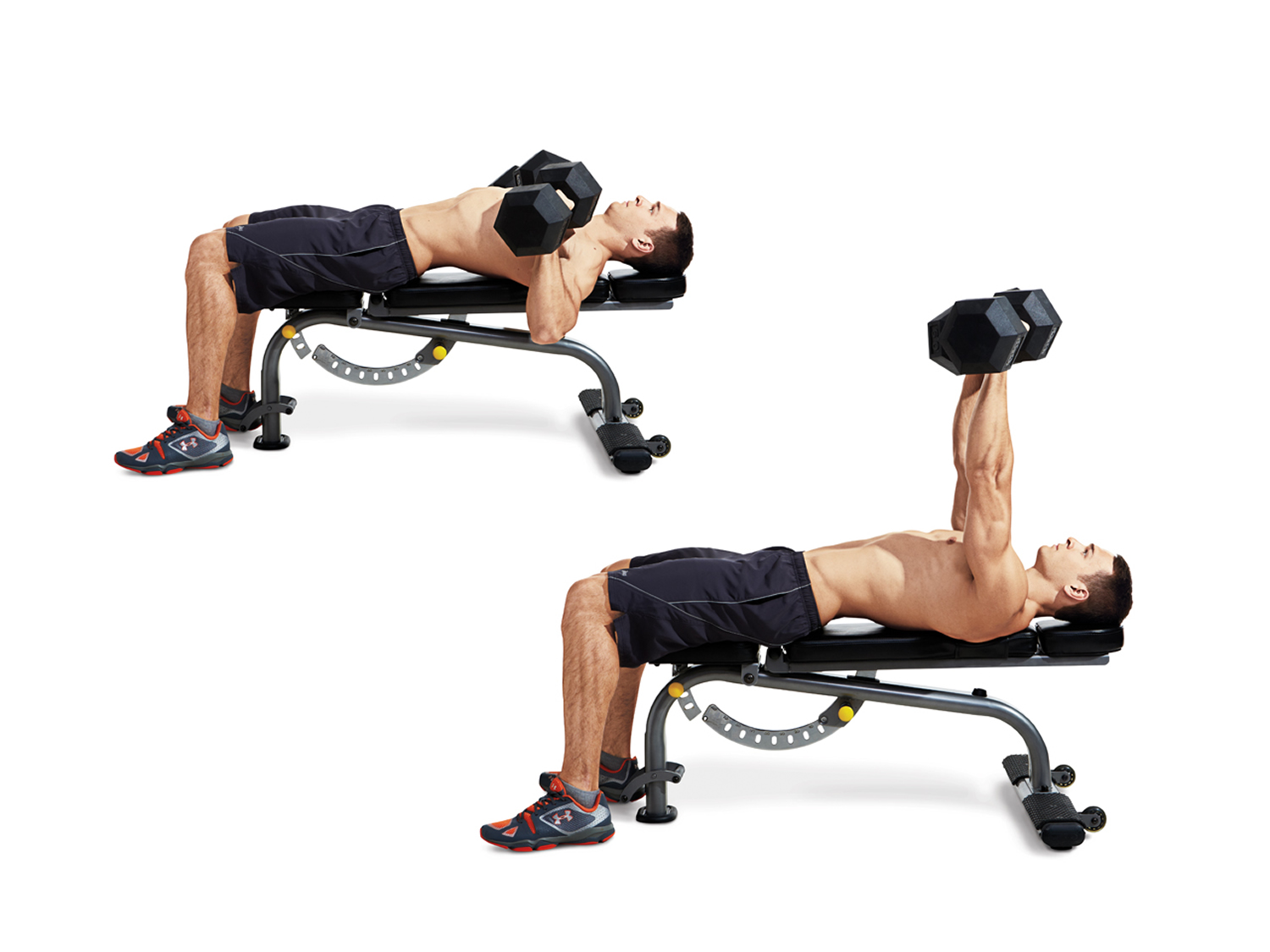
1. Bench Press

The bench press is one of the most popular and effective exercises for building upper body strength. It primarily targets the chest (pectorals), shoulders (deltoids), and arms (triceps and biceps).

To perform this exercise, lie flat on a bench and lift a barbell weight up and down in a controlled motion. Make sure your feet are flat on the ground and your shoulder blades are pulled together for better stability and support. Proper form is essential to avoid injury and maximize muscle engagement.


2. Bicep Curls

Bicep curls are a classic exercise for building arm strength and size. They are typically performed using dumbbells, but you can also use barbells or EZ bars depending on your preference.

This exercise mainly targets the biceps while also engaging the triceps for elbow stability. One of the great things about bicep curls is their versatility—there are many variations you can incorporate into your routine to keep your workouts interesting and effective.


3. Leg Raises

Leg raises are an excellent exercise for strengthening your core, especially the abdominal muscles. To do this exercise, lie flat on your back, lift your legs straight up, and slowly lower them back down without letting them touch the ground.

Keeping your legs straight makes the exercise more challenging and effective. Slightly bending your knees can make it easier, but it may reduce the intensity of the workout.


4. Running

Running is a simple yet powerful exercise that not only helps build abdominal muscles but also burns excess body fat. It’s one of the most popular forms of exercise worldwide due to its accessibility.

To get the most out of running, make sure you wear proper shoes that support your posture and reduce the risk of injury. Additionally, learning how to control your breathing will help you maintain endurance and avoid fatigue.


5. Push-Ups

Push-ups are a highly effective bodyweight exercise that can be done anywhere, making them perfect for home workouts. They target multiple muscle groups, including the biceps, triceps, chest, and core.

In addition, push-ups also engage your back muscles to some extent. Because they require no equipment and are easy to modify, push-ups are a convenient and efficient way to build muscle strength.


6. Chin-Ups

Chin-ups are excellent for developing upper body strength, especially in the back and arms. This exercise primarily works the triceps and back muscles.

You can usually find chin-up bars in gyms or public parks. If you prefer working out at home, there are also portable chin-up bars available that can be installed easily.


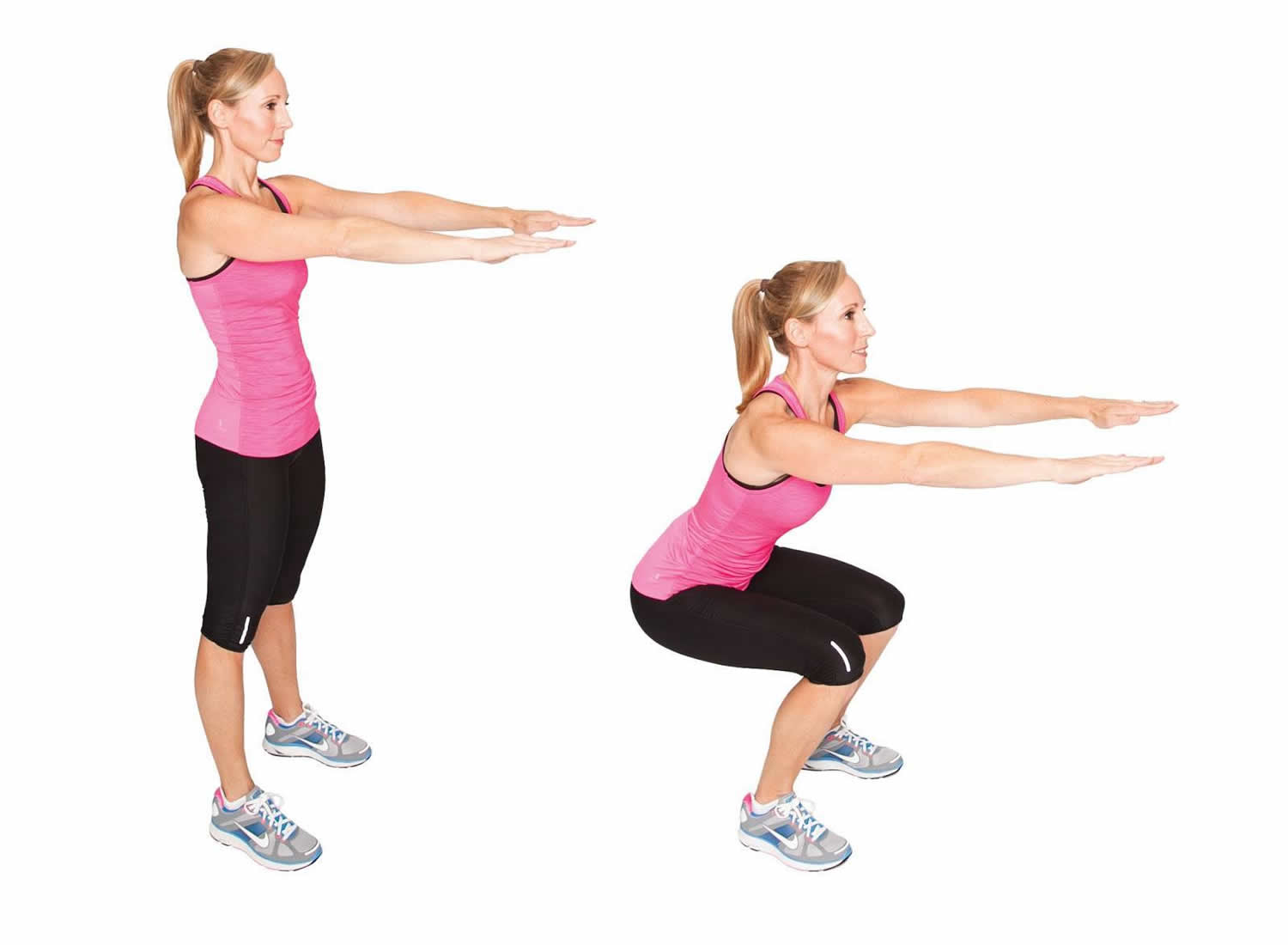
7. Squats

Squats are one of the best lower-body exercises for building strength in your calves and thighs. Like push-ups, squats can be performed almost anywhere without the need for equipment.

They are highly effective for improving balance, stability, and overall lower-body muscle development. To get the best results, focus on maintaining proper posture and controlled movement throughout the exercise.


Final Thoughts

Incorporating these seven workout routines into your fitness plan can help you build muscle more effectively. The key is consistency, proper technique, and gradually increasing intensity over time.

Whether you’re a beginner or more advanced, these exercises provide a solid foundation for achieving a stronger, healthier, and more muscular body. 💪


What is the best workout routine for building muscle ?

What is the best workout routine for building muscle ?

What is the best workout routine for building muscle ?


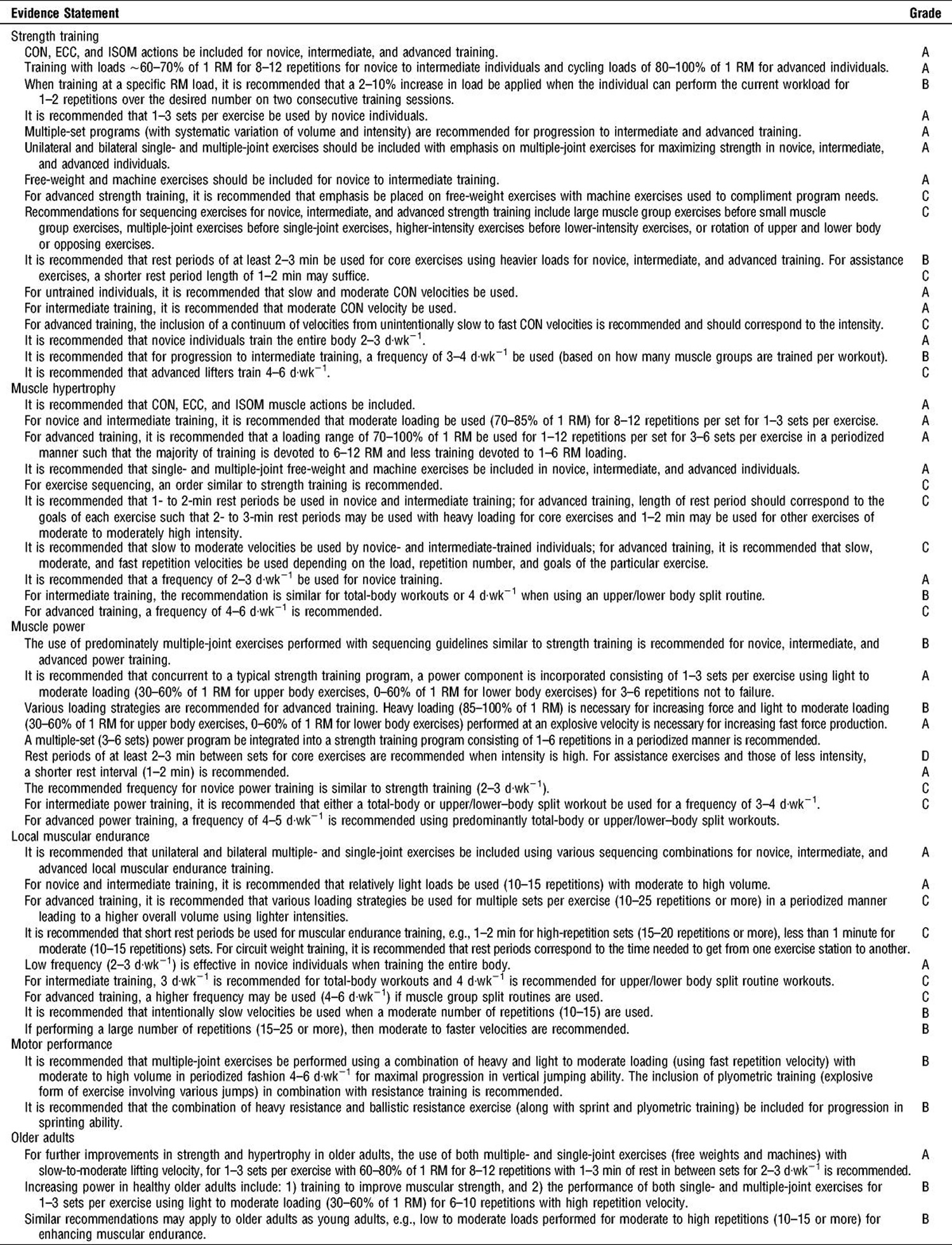
The American College of Sports Medicine (ACSM) recommends that a strength training program should be performed a minimum of two non-consecutive days each week, with one set of 8 to 12 repetitions for healthy adults or 10 to 15 repetitions for older and frail individuals 1. Eight to 10 exercises should be performed that target the major muscle groups 1. Examples of typical resistance exercises that can be performed using free-weights, machines, or body weight for the major muscle groups are:


Table 1. RESISTANCE TRAINING GUIDELINES AND EXERCISES


Free-Weight

Machine-Based

Body Weight

Chest

Supine Bench Press

Seated Chest Press

Push-ups

Back

Bent-over Barbell Rows

Lat Pulldown

Pull-ups

Shoulders

Dumbell Lateral Raise

Shoulder Press

Arm Circles

Biceps

Barbell/Dumbell Curls

Cable Curls

Reverse Grip Pull-ups

Triceps

Dumbell Kickbacks

Pressdowns

Dips

Abdomen

Weighted Crunches

Seated “Abs” Machine

Crunches, Prone Planks

Quadriceps

Back Squats

Leg Extenstion

Body weight lunges

Hamstrings

Stiff-leg Deadlifts

Leg Curls

Hip-ups

[Source: The American College of Sports Medicine – Resistance Training for Health and Fitness 1]

The American College of Sports Medicine (ACSM) stresses the importance of progressing resistance training programs to meet specific resistance training goals. Progression in resistance training may be defined as “the act of moving forward or advancing toward a specific goal over time until the target goal has been achieved,” whereas maintenance resistance training refers to programs designed to maintain the current level of muscular fitness 1. This can occur with specific trainable characteristics of muscular fitness, such as strength, power, muscle hypertrophy and local muscular endurance. These four factors will improve with almost any properly designed resistance training program, but will be fully enhanced by properly modifying the load, volume, rest period between sets, and the frequency of each workout.

Countless resistance training models can be effective if these principles are incorporated and manipulated into the design. The magnitude of improvement depends upon the individual’s training status and genetic predisposition 2. Progressive overload is the gradual increase of stress placed upon the body during exercise training. Among untrained or novice populations, physiological adaptations to an resistance training program may occur in a short period. Systematically increasing the demands placed upon the body is necessary for further improvement and may be accomplished through altering one or more of the following variables:

  1. Exercise intensity (i.e., absolute or relative resistance/load for a given exercise/movement) may be increased;
  2. Total repetitions performed at the current intensity may be increased;
  3. Repetition speed/tempo with submaximal loads may be altered according to goals;
  4. Rest periods may be shortened for endurance improvements or lengthened for strength and power training; and
  5. Training volume (total work represented as the product of the total number of repetitions performed and the resistance) may be gradually increased (e.g., 2.5-5% 75) (Table 2).

Table 2. Muscle Building Workout Plan

muscle building workout plan
[Source 3]

Note: CON = the motion of an active muscle while it is shortening under load (contracting) ; ECC = the motion of an active muscle while it is lengthening under load; ISOMstatic strength training, involve muscular actions in which the length of the muscle does not change and there is no visible movement at the joint (no movement).

Muscle Action

Most resistance training programs primarily include dynamic repetitions with both concentric (CON; muscle shortening) and eccentric (ECC; muscle lengthening) muscle actions, whereas isometric (ISOM; no net change in muscle length) actions play a secondary role (e.g., during nonagonist muscle stabilization, core strength, grip strength, pauses between eccentric (ECC) and concentric (CON) actions, or specific agonist ISOM exercises). Greater force per unit of muscle size is produced during eccentric (ECC) actions 4 than either CON or ISOM actions. Moreover, eccentric (ECC) actions require less motor unit activation per specific load 4, are less metabolically demanding 5, and are conducive to promoting hypertrophic adaptation 6 yet result in more pronounced delayed onset muscle soreness 7 as compared with concentric (CON) actions. Dynamic concentric (CON) muscular strength improvement is greatest when ECC actions are included with CON actions 8, and independently, ECC isokinetic training has been shown to produce greater muscle action-specific strength gains than CON training 9. The role of muscle action manipulation during resistance training is minimal with respect to overall progression because most programs include both CON and ECC actions in a given repetition. However, the inclusion of additional ISOM exercise may be beneficial. In some programs, the use of different forms of ISOM training, for example, functional ISOM 10 and supramaximal ECC actions (Keogh JWL, Wilson GJ, Weatherby RP. A cross-sectional comparison of different resistance training techniques in the bench press. J Strength Cond Res. 1999;13:247-58.)), has been reported to produce additional benefit. Specifically, certain ISOM actions have been recommended for promoting low back health and have been demonstrated effective for the selective recruitment of postural, spinal-stabilization musculature 11.

Repetition Speed

Less is known concerning the effect of repetition velocity on hypertrophy. In untrained individuals, fast (1:1) and moderate to slow (3:3) velocities of training produced similar changes in elbow flexor girth after 6 wk of training 12. However, 8 wk of fast (210°·s−1) ECC isokinetic training produced larger increases in Type II muscle fiber CSA than slow (20°/second) training 13, and 8 wk of fast ECC (180°·s−1) isokinetic training produced greater hypertrophy than slow ECC (30°/second), fast and slow CON training 9. For dynamic constant external resistance training, it has been suggested that higher velocities of movement pose less of a stimulus for hypertrophy than slow and moderate velocities. However, intentional slow velocities require significant reductions in loading and result in less of a blood lactate response and less metabolic response when total training time is equated 14. It does appear that the use of different velocities is warranted for long-term improvements in hypertrophy for advanced training.

It is recommended that slow to moderate velocities be used by novice- and intermediate-trained individuals. For advanced training, it is recommended that slow, moderate, and fast repetition velocities be used depending on the load, the repetition number, and the goals of the particular exercise 15, 16.

Exercise Selection

Both single- and multiple-joint exercises have been shown to be effective for increasing muscular strength in the targeted muscle groups using multiple modalities, for example, free weights, machines, cords, etc. 17, 18. Multiple-joint exercises, such as bench press and squat, require complex neural responses 19 and have generally been regarded more effective for increasing overall muscular strength because they enable a greater magnitude of weight to be lifted 20. Single-joint exercises, such as knee extensions and knee curls, have been used to target-specific muscle groups and pose a reduced level of skill and technical involvement. It is important to note that alterations in body posture, grip, and hand width/foot stance and position change muscle activation and alter the exercise. Thus, many variations or progressions of single- and multiple-joint exercises can be performed. Another way to vary exercise selection is to include unilateral as well as bilateral exercises. The level of muscle activation differs when an exercise is performed bilaterally versus unilaterally. Unilateral training may increase bilateral strength (in addition to unilateral strength), and bilateral training may increase unilateral strength 21. Unilateral training has been shown to improve some aspects of sports performance, such as single-leg jumping ability to a greater extent than bilateral training 21. Of interest has been the performance of single- and multiple-joint exercises in unstable environments, for example, with stability balls, wobble boards, and BOSU balls 22. These exercises have been shown to increase the activity of lower torso musculature and other stabilizer muscles (compared with stable environments); however, the magnitude of agonist force production is considerably lower resulting in lighter weights lifted 23. There are a multitude of exercises that can be performed in a variety of conditions that leaves many options for resistance training variation.

Free Weights and Machines

Weight machines have been regarded as safer to use, easy to learn, and allow performance of some exercises that may be difficult with free weights, for example, knee extension. Machines help stabilize the body and limit movement about specific joints involved in synergistic force production, and machine exercises have demonstrated less neural activation when matched for intensity for most comparisons to free-weight exercises 24. Unlike machines, free weights may result in a pattern of intra- and intermuscular coordination that mimics the movement requirements of a specific task. Both free weights and machines are effective for increasing strength. Research shows that free-weight training leads to greater improvements in free-weight tests and machine training results in greater performance on machine tests 25. When a neutral testing device is used, strength improvement from free weights and machines appears similar 26. The choice to incorporate free weights or machines should be based on level of training status and familiarity with specific exercise movements as well as the primary training objective.

Exercise Order

The sequencing of exercises significantly affects the acute expression of muscular strength 27. This also applies when exercises are sequenced based on agonist/antagonist muscle group relationships. Muscle force and power may be potentiated when opposing exercises (antagonist movements) are performed 28; however, force and power may be reduced if the exercises are performed consecutively 29. Studies show that multiple-joint exercise (bench press, squat, leg press, and shoulder press) performance declines significantly when these exercises are performed later (after several exercises stressing similar muscle groups) rather than early in a workout 30. Considering that these multiple-joint exercises have been shown to be effective for increasing strength, maximizing performance of these exercises by performing them early in a workout may be necessary for optimal strength gains 31.

Recommendations for sequencing exercises for novice, intermediate, and advanced strength training for total body (all muscle groups trained in the workout), upper/lower body split (upper-body musculature trained 1 d and lower-body musculature trained another day), and muscle group split (individual muscle groups trained during a workout) workouts include large muscle group exercises before small muscle group exercises, multiple-joint exercises before single-joint exercises, higher-intensity exercises before lower-intensity exercises, or rotation of upper and lower body or agonist-antagonist exercises, that is, exercise performed for a muscle group followed by an exercise for the opposing muscle group 32.

Adding High-Intensity Interval Training (HIIT) Workout To Your Weight Training Program

Traditionally, resistance training often is performed separately from aerobic training — typically on two or three nonconsecutive days each week. The American College of Sports Medicine recommends 8 to 12 repetitions of a resistance training exercise for each major muscle group at an intensity of 40% to 80% of a one-repetition max (1RM) depending on the training level of the participant. Two to three minutes of rest is recommended between exercise sets to allow for proper recovery. Two to four sets are recommended for each muscle group 1.

Standard guidelines for aerobic training recommend 150 minutes per week of moderate-intensity exercise (46% to 63% of maximal oxygen uptake, VO2max) for 30 to 60 minutes per session and/or 75 minutes per week of vigorous-intensity exercise (64% to 90% V˙O2max) for 20 to 60 minutes per session 1.

To address the limitations of traditional exercise protocols and provide an effective and efficient program for you, one of the exercise strategies to use is high intensity interval training (HIIT) using body weight as resistance. The approach combines aerobic and resistance training into a single exercise bout lasting approximately 7 minutes. Participants can repeat the 7-minute bout 2 to 3 times, depending on the amount of time you have. As body weight provides the only form of resistance, the program can be done anywhere.

High intensity interval training programs include short bursts of high-intensity activity performed at maximal effort (80-95 percent peak oxygen intake or VO2 max), separated by short periods of low-intensity work that allow partial recovery. The recovery periods may last equally as long as the work periods and are usually performed at 40% to 50% of a person’s estimated maximal heart rate. The workout continues with the alternating work and relief periods totaling 20 to 60 minutes. Two HIIT sessions a week is plenty, in addition to your other weight training workouts.

High-intensity interval training involves repeated short (<45 seconds) to long (2-4 minutes) bouts of rather high-intensity exercise interspersed with recovery periods. A typical high-intensity interval training session might include a three-minute warmup, four to six repetitions of a 30-second sprint followed by a 60-second active recovery, and a three-minute cool-down 33. High intensity interval training is not as complicated as you might think. Interval training is simply alternating bursts of intense activity with intervals of lighter activity. For instance, if your exercise is walking — if you’re in good shape, you might incorporate short bursts of jogging into your regular brisk walks. If you’re less fit, you might alternate leisurely walking with periods of faster walking. For example, if you’re walking outdoors, you could walk faster between certain mailboxes, trees or other landmarks.

High-Intensity Interval Resistance Training (HIRT) can be a fast and efficient way to lose excess body weight and body fat 34, 35, 36, 37. It has been proposed that short period resistance training  could play a role in weight control by increasing resting energy expenditure but the effects of different kinds of resistance training has not been widely reported. The incorporated resistance training contributes significantly to the amount of fat burned during a workout 38. When resistance training exercises using multiple large muscles are used with very little rest between sets, they can elicit aerobic and metabolic benefits 39, 40, 35. Research has found that these metabolic benefits can be present for up to 72 hours after a high-intensity exercise bout has been completed 41.

There also may be a greater impact on subcutaneous fat loss with high-intensity intermittent circuit-style resistance training protocols than with traditional steady state sustained-effort aerobic work or traditional resistance training. This is thought to be from the increased level of catecholamines and growth hormone found in the blood both during and after high-intensity resistance training exercise with shortened rest periods (<30 seconds) 42, 35.

Shorter rest periods result in a shorter total exercise time. This is attractive to individuals who are trying to maximize the impact of an exercise program in minimal time.

In a small study involving 17 men doing resistance training, who were separated into doing the High-Intensity Interval Resistance Training (HIRT) consisting of: 6 repetitions, 20 seconds rest, 2/3 repetitions, 20 secs rest, 2/3 repetitions with 2 mins 30 seconds rest between sets, three exercises for a total of 7 sets. And the Traditional Resistance Training  consisted of eight exercises of 4 sets of 8–12 repetitions with one/two minutes rest with a total amount of 32 sets. The researchers measured basal resting energy expenditure before the exercise and at 22 hours after the training session.

This data 43 suggest that shorter high-intensity interval resistance training sessions may increase resting energy expenditure at 22 hours after exercise to a greater extent than traditional resistance training and improving fat oxidation. The shorter exercise time commitment may help to reduce one major barrier to exercise.

Rest Periods

The amount of rest between sets and exercises significantly affects metabolic, hormonal and cardiovascular responses to an acute bout during resistance exercise as well as performance of subsequent sets and training adaptations. Acute resistance exercise performance may be compromised with one versus 3-min rest periods 44, and strength recovery may not be complete within 3 min 45. Several studies have shown that the number of repetitions performed may be compromised with short rest intervals, and 3- to 5-min rest intervals produce less performance decrements than 30 s to 2 min 46. In untrained individuals, circuit RT programs (using minimal rest in between exercises) have been shown to produce modest increases in strength 47. However, most longitudinal training studies have shown greater strength increases with long versus short rest periods (e.g., 2-5 min vs 30-40 s [3,213,230]), and one study has shown a lack of strength increase with 40-s rest periods 48. It is important to note that rest period length will vary based on the complexity of a given exercise (e.g., Olympic lifts and variations require longer rest periods) and the primary objective for incorporating the exercise into the training program (i.e., not every exercise will use the same rest interval).

For novice, intermediate, and advanced training, it is recommended that rest periods of at least 2-3 min be used for core exercises using heavier loads (those exercises included specifically to improve maximal strength such as the squat and bench press).

For assistance exercises (those exercises complimentary to core exercises), a shorter rest period length of 1-2 min may suffice 49.

Muscular Loading

The load is the amount of weight lifted in a given set, which is based on a percentage of the 1-repetition maximum (1RM). The volume is the total number of exercises, repetitions, and sets that are performed in a given exercise session. Rest period is the time period between each set and exercise. Frequency refers to the number of exercise sessions per week. How to manipulate each of these for the optimal enhancement of strength, power, hypertrophy, or muscular endurance is described below.

Altering the training load affects the acute metabolic, hormonal, neural, and cardiovascular responses to resistance exercise. Depending on an individual’s training experience and current level of fitness, proper loading during resistance training encompasses one or more of the following loading schemes:

  1. Increasing load based on a percentage of 1 RM,
  2. Increasing absolute load based on a targeted repetition number, or
  3. Increasing loading within a prescribed zone (e.g., 8-12 RM).

The load required to increase maximal strength in untrained individuals is fairly low. Loads of 45-50% of 1 RM (and less) have been shown to increase dynamic muscular strength in previously untrained individuals 50. Light loads that can be lifted a maximum of 15-25 repetitions have been shown to increase strength in moderately trained individuals 51. It appears greater loading is needed with progression. At least 80% of 1 RM is needed to produce further neural adaptations and strength during resistance training in experienced lifters 52. Several pioneering studies indicated that training with loads corresponding to 1-6 RM (mostly 5-6 RM) was most conducive to increasing maximal dynamic strength 53. Strength increases have been shown to be greater using heavy weights for 3-5 RM compared with 9-11 and 20-28 RM 54. Although significant strength increases have been reported using loads corresponding to 8-12 RM and lighter (33,149,250), this loading range may be inferior for maximizing strength in advanced lifters 52. Research examining periodized resistance training has demonstrated a need for variable-intensity loading schemes 55. Contrary to early suggestions of 6 RM loading, it appears that using a variety of training loads is most conducive to maximizing muscular strength 55. Meta-analytical data have shown that 60% of 1 RM produced the largest effect sizes for strength increases in novice individuals whereas 80% of 1 RM produced the largest effect sizes for strength increases in trained individuals 56 and 85% of 1 RM was most effective in athletes 57. For novice individuals, it has been suggested that moderate loading (50-60% of 1 RM or less) be used initially as learning proper form, and technique is paramount. These dose-response data refer to average training dosages, that is, mean loads used for all exercises. Further, using a variety of loads appears to be most effective for long-term progression in muscular strength 18. Recent studies have shown that self-selected resistance training intensities are lower than what is recommended, for example, 38-58% of 1 RM 58. Thus, intensity needs to be prescribed above one’s threshold (based on targeted repetition number) for progression in experienced populations.

Training Volume

Training volume is a summation of the total number of repetitions performed during a training session multiplied by the resistance used (kg) and is reflective of the duration of which muscles are being stressed 59. Training volume has been shown to affect neural, hypertrophic, metabolic and hormonal responses and subsequent adaptations to resistance training. Altering training volume can be accomplished by changing the number of exercises performed per session, the number of repetitions performed per set, or the number of sets per exercise. Low-volume programs, for example, high load, low repetitions, moderate to high number of sets, have been characteristic of resistance training. Studies using two 60, 61, three 44, 62, four to five 8, 63, and six or more 64, 65 sets per exercise have all produced significant increases in muscular strength in both trained and untrained individuals. In direct comparison, studies have reported similar strength increases in novice individuals between two and three sets 66 and two and four sets 67, whereas three sets have been reported superior to one and two 68. Although little is known concerning the optimal number of sets performed per muscle group per session, a meta-analysis of 37 studies has shown that approximately eight sets per muscle group produced the largest effect size in athletes 69, 70.

Another aspect that has received considerable attention is the comparison of single- and multiple-set programs. In many of these studies, one set per exercise performed for 8-12 repetitions at a relatively slow velocity has been compared with both periodized and nonperiodized multiple-set programs. A common criticism of these investigations is that the number of sets per exercise was not controlled from other variables such as intensity, frequency, and repetition velocity. Notwithstanding this concern, most research investigations comparing single- versus multiple-set training for muscular fitness have examined the effects of a standard single-set training program relative to that of any number of possible multiple-set programs of varying intensity. This design has made the process of identifying a clear-cut prescription recommendation very difficult because these studies have yielded conflicting results. Several studies have reported similar strength increases between single- and multiple-set programs 71, 72, whereas others reported multiple-set programs superior 73, 74 in previously untrained individuals. Since 2002, six studies have shown multiple-set superiority for 33-100% of the dynamic strength assessments used, whereas the remaining dynamic strength assessments showed similar increases. These data have prompted the notion that untrained individuals respond favorably to both single- and multiple-set programs and formed the basis for the popularity of single-set training among general fitness enthusiasts 75. In resistance-trained individuals, multiple-set programs have been shown to be superior for strength enhancement 76, 44, 77 in all but one study 78. Among resistance-trained postmenopausal women, multiple-set training led to 3.5-5.5% strength increases, whereas single-set training led to −1% to 2% strength reductions 76. No comparative study has shown single-set training superior to multiple-set training in trained or untrained individuals.

The results of meta-analytical studies have shown multiple-set resistance training superior to single sets for strength enhancement in untrained 79, 56 and trained populations 80 and superior for strength increases for programs lasting 17-40 wk 80. These studies have shown that performing three to four sets per exercise produced the most substantial effect sizes 79, 56. Thus, it appears that both program types are effective for increasing strength in untrained to moderately trained individuals during relatively short-term training periods. Long-term studies support the contention that a moderate increase in training volume is needed for further improvement. However, there is a point where further increase in volume may be counterproductive. In weightlifters, a moderate volume was shown to be more effective for increasing strength than low or high volumes of training with similar intensity 81. The key factor may be variation of training volume (and its interaction with intensity) rather than absolute number of sets.

Muscular Strength

The ability to generate force is necessary for all types of movement. Muscle fiber cross-sectional area (CSA) is positively related to maximal force production 82. The arrangement of fibers according to their angle of pennation, muscle length, joint angle, and contraction velocity can alter the expression of muscular strength 83. Force generation is further dependent upon motor unit activation, and motor units are recruited according to their recruitment threshold that typically involves the activation of the slower (lower force-producing) motor units before the faster (higher force-producing) units, that is, size principle 84. Adaptations to resistance training enable greater force generation through numerous neuromuscular mechanisms. Muscle strength may increase significantly within the first week of training 85, and long-term strength enhancement manifests itself through enhanced neural function (e.g., greater recruitment, rate of discharge), increased muscle fiber cross-sectional are, changes in muscle architecture and possible adaptations to increased metabolites, for example, H+, for increased strength. The magnitude of strength enhancement is dependent on the type of program used and the careful prescription of muscle actions, intensity, volume, exercise selection and order, rest periods between sets, and frequency.

Muscular strength is the ability of a muscle or muscle group to exert a maximal external force.

  • Load: 60-70% 1RM for novice to intermediate; 80-100% for advanced
  • Volume: 1-3 sets of 8-12 repetitions for novice to intermediate; 2-6 sets of 1-8 repetitions for advanced
  • Rest period: 2-3 min for higher intense exercises that use heavier loads; 1-2 minutes between the lower intense exercises with light load.

Muscular Power

Power is defined as the optimal amount of work performed in a given time period. Muscular power is the highest power output attainable during a particular movement, and is required in activities of daily living, sport, and work. For optimal improvements in muscular power, a light load of 0 to 60% of 1RM should be used for 3-6 repetitions over one to three sets per exercise.

  • Load: 30-60% 1RM for upper body exercises; 0-60% 1RM for lower body exercises
  • Volume: 1-3 sets of 3-6 repetitions per exercise
  • Rest period: 2-3 min for higher intense exercises that use heavier loads; 1-2 minutes between the lower intense exercises with light load.

Muscular Hypertrophy

Muscular hypertrophy is the enhancement of muscle size.

  • Load: 70-85% 1RM for novice to intermediate; 70-100% for advanced
  • Volume: 1-3 sets of 8-12 repetitions for novice to intermediate; 3-6 sets of 1-12 repetitions for advanced
  • Rest period: 2-3 min for higher intense exercises that use heavier loads; 1-2 minutes between the lower intense exercises with light loads.

Muscular Endurance

Local muscular endurance is the ability of a muscle or a muscle group to repeatedly exert a submaximal resistance.

  • Load: lower than 70% of 1RM
  • Volume: 2-4 sets of 10-25 repetitions
  • Rest period: 30 seconds to 1-minute between each set.

Frequency

For all the above, it is recommended that novice individuals train the entire body 2-3 days per week. Intermediate individuals should train 3 days if using a total-body workouts or 4 days if using an upper/lower body split routine, training each major muscle group twice per week. Advanced lifters can train 4-6 days per week, training each major muscle group once to twice per week. At this level, muscle group split routines of one to three muscle groups trained per workout are common since this would allow a higher volume per muscle group. Elite weightlifters and bodybuilders may benefit from using very high frequencies such as, two workouts per day for 4-5 days per week.

Optimal resistance training frequency (the number of workouts per week) depends upon several factors such as volume, intensity, exercise selection, level of conditioning, recovery ability, and number of muscle groups trained per workout session. Numerous studies have used frequencies of two to three alternating days per week in previously untrained individuals 86. This frequency has been shown to be an effective initial frequency, whereas 1-2 days per week appears to be an effective maintenance frequency for those individuals already engaged in resistance training 87. In several studies comparing strength gains, 1) 3 d of training per week was superior to 1 day 88 and 2 days 89, 2) 3 days produced similar strength increases to 2 days per week when volume was equated 86, 3) 4 days per week was superior to three 90, 4) 2 days per week was superior to 1 day 91, and 5) 3-5 days per week was superior to 1 and 2 d 92. Meta-analytical data have shown that strength gains in untrained individuals were highest with a frequency of 3 days per week 56.

Optimal progression of frequency during advanced training varies considerably. It has been shown that football players training 4-5 days per week achieved better results than those who trained either 3 or 6 days per week 93. Advanced and elite weightlifters and bodybuilders use high-frequency training, for example, four to six sessions per week or more. Double-split routines (two training sessions per day with emphasis on different muscle groups) are common during training 94, which may result in 8-12 training sessions per week. Frequencies as high as 18 sessions per week have been reported in elite Olympic weightlifters 95. The rationale for high-frequency training is that frequent short sessions followed by periods of recovery, nutrition supplementation, and food intake allow for high-intensity training and performance (reduced fatigue). Häkkinen and Kallinen 96 reported greater increases in muscle cross-sectional area (CSA) and strength when training volume was divided into two sessions per day as opposed to one. Elite power lifters train 4-6 days per week 97. It is important to note that not all muscle groups are trained per workout during a high-frequency model of training. Meta-analytical data have shown that training a muscle group two times per week in advanced individuals yielded the highest effect size 98 and two to three times per week yielded similar effect sizes in athletes 69.

It is recommended that advanced lifters train 4-6 days per week. Elite weightlifters and bodybuilders may benefit from using very high frequency, for example, two workouts in 1 day for 4-5 days per week.

Overtraining

To reduce the risk of overtraining, a dramatic increase in volume should be avoided. It is recommended that a 2-10% increase in the load be applied when the individual can comfortably perform the current workload for one to two repetitions over the desired number on two consecutive training sessions.

Strength Training Program for Your Home

Muscular strength and endurance is a component of fitness that is necessary for optimal well-being and quality of life. Unfortunately, the cost of joining a health club or gym is a major barrier for many people who want to do resistance training. Membership costs vary depending on the city and facility’s services, but fees generally range from $25 to $100 per month. Additional initiation fees may run into the hundreds. In addition, the inconvenience of traveling to a facility and working out with strangers is not appealing to everyone.

A cost-effective and convenient alternative to a gym membership is turning your living room or basement into your own personal training facility. Of course your home gym will not have expensive strength training machines, such as hip sleds or assisted pull-up machines. However, with a moderate investment and a good imagination, you can get a great workout in the comfort of your own home.

What You Need

  • Space. You’ll need an open space that allows freedom of movement and is void of hazards that you might step on, bump into or trip over. A rearranged living room or an open garage stall with adequate traction will work well. You will need about 100 square feet (10′ x 10′).
  • Equipment. Invest in a few dumbbells (new about $0.50 per pound) or resistance bands and a stability ball. Most strength training exercises can be performed with this basic equipment. An adjustable bench that changes angles for your upper body is not necessary, but it would offer additional variety.
  • Plan. Don’t begin resistance training until you have developed a plan. It is important that you have a structured program that includes 8-10 exercises to target the major muscle groups of the body. It is always wise to consult a local fitness expert and follow the American College of Sports Medicine (ACSM) guidelines above for strength training. If you are a novice, a fitness professional will be able to give you advice beyond what is described here. Perform 1-3 sets of 8-12 repetitions at least twice a week. Make sure to do a brief warm-up before starting your session.

Tips for Strength Training

  • Control the weight. It is important to perform each exercise in a controlled manner. Lower the weight slowly since you are working the same muscles as when you are lifting. To control speed of movement, try using a one-two-three count. The up phase (concentric or lifting) is completed quickly to a count of “one,” and the down phase (eccentric or lowering) is completed slowly to a count of “two-three.” To maintain sport performance and prevent injury throughout the whole range of motion, strengthening both phases of muscle contraction is important. Resistance exercise programs are therefore recommended for muscle health and strength across the age span. Eccentric strength is especially important for balance, mobility and physical functions such as walking down stairs or lowering objects to the ground. Traditional strength training eccentric programs typically involve lifting a weight in the concentric phase for 2 seconds and lower a weight in the eccentric phase for ~4-6 seconds to maximize strength gain. Because the muscle forces that are generated during slow eccentric overloading are high compared to traditional concentric resistance exercise, 3-5 days of rest should be provided between days of exercise. This recovery time allows the muscle to repair, adapt and prepare for the next exercise session.
  • Breathe. Ideally, you should exhale when the weight is being raised and inhale when the weight is being lowered. Don’t ever hold your breath. It might help to count out loud the one-two-three count during the movement.
  • Go to failure. An estimated 70 percent of strength gains can occur in the first set of training if performed to failure, otherwise called “rep out.” Failure or “repping out” means doing as many reps as possible for whatever resistance selected. Going to failure is challenging, but it will maximize your fitness response in a minimal amount of time. The takeaway is that you can get away with doing only one set if you perform that set to failure. Ideally, you should select a weight so that you fail between 8-12 repetitions. As you get stronger, you will need to increase the weight or the repetitions to elicit more gains.
  • Progress slowly. The famous saying “Rome wasn’t built in a day” applies here. Don’t expect miraculous results immediately. Rather, work toward your goals slowly, and appreciate the process of being active. During your first few workouts, use a light resistance, focus on your form and don’t go to failure just yet. Also, be sure to allow time for recovery between sets (30-120 seconds) and between workouts (1-2 days). Your first few workouts might only last 15-20 minutes.
  • Include variation. It is not unusual for workouts to become stale and for fitness gains to level off. These plateaus are expected and indicate that you are becoming more trained. Don’t get discouraged. If your workout gets old and boring, try different exercises and vary the number of repetitions, the weight or resistance, and the amount of rest between sets. These changes are likely to stimulate muscle adaptation and promote greater enjoyment of exercise.

Although it is impossible to improve at the same rate over long-term periods (e.g., >6 months), the proper manipulation of program variables (choice of resistance, exercise selection and order, number of sets and repetitions, frequency, and rest period length) can limit training plateaus and increase the ability to achieve a higher level of muscular fitness. Trainable characteristics include muscular strength, power, hypertrophy, and local muscular endurance. Variables such as speed and agility, balance, coordination, jumping ability, flexibility, and other measures of motor performance may be enhanced by resistance training. Resistance training, when incorporated into a comprehensive fitness program, improves cardiovascular function 99, reduces the risk factors associated with coronary heart disease 100 and non-insulin-dependent diabetes 101, prevents osteoporosis 102, may reduce the risk of colon cancer 103, promotes weight loss and maintenance 104, improves dynamic stability and preserves functional capacity 104, and fosters psychological well-being 105.

  • Add on. Creating your own home gym is not a massive financial obligation and will not take much space. Over time, add more equipment to your collection, and continue to expand the possibilities of your home training center. For example, build on to your collection with a medicine ball, Bosu® ball or additional free weights.
  • Do something. When it comes to strength training—and exercise in general—doing something is truly better than continuing to be sedentary. Of course, more is better than some, and it’s possible to train too much. It is not necessary to join a gym to enjoy the benefits of strength training. You can definitely do some in the comfort of your own home.

Full Body—A Sample Home Workout Plan

Squat—for hips, thighs and buttocks

  1. From the sitting position with your feet shoulder-width apart and your toes in front of your knees, lean forward slightly and stand up without locking your knees.
  2. Slowly lower your body back to a seated position where your upper legs are approximately parallel to the floor.
  3. Alternative—Place a stability ball between your middle-back and a wall, and lean back into the ball while performing these same movements.

Figure 1. Squat

Squat

Chest Press—for chest muscles and triceps

  1. Lie on your back with your feet flat and knees bent.
  2. Grip dumbbells and extend upward but don’t lock the elbows. Slowly lower to the starting position.
  3. Alternatives—Sit on a stability ball and perform same movement. Simple pushups also work these muscles. A variation in push-ups could be putting your feet on a chair simulating an incline chest press.

Figure 2. Chest Press

Chest Press

Back Extension—for buttocks (gluteals) and low back

  1. Lie face down on the floor.
  2. Raise left arm and right leg off the floor with head and neck in line with the arm. Hold for 1-2 seconds, and then slowly lower the arm and leg back to the starting position. Repeat this movement for the right arm and left leg.
  3. Alternative—Perform the movement on all fours or lying face down on a stability ball.

Figure 3. Back Extension

Back Extension


Standing Lunges—for front of thighs (quadriceps) and buttocks

  1. With one leg, step backward until the thigh of the forward leg is parallel to the ground or as far as feels comfortable. Your back knee should come close to the floor but not touch it.
  2. Push with the front leg, driving your heel into the floor, to return to the starting position.
  3. Alternative—Using a regular-height chair, do bench step-ups from the floor in an “up-up-down-down” pattern. To increase resistance in this exercise, hold dumbbells in your hands.

Figure 4. Standing Lunges

Standing Lunges

Dumbell Shoulder Press—for shoulders

  1. Perform this movement sitting in a regular chair, standing or sitting on a stability ball. Hold a dumbbell in each hand with an overhand grip. Make a 90-degree angle with your arms by raising the dumbbells so they are level with your ears.
  2. Slowly raise dumbbells over your head until arms are fully extended, but do not lock your elbows. Slowly lower the dumbbells to the starting position.
  3. Alternative—Perform a lateral raise by lifting the arms to the sides with a slight bend in the elbows. Keep the weights and arms below shoulder height. You will likely need lower weight for this exercise compared to shoulder press.

Figure 5. Dumbell Shoulder Press

Dumbell Shoulder Press

Pelvic Tilt—for abdominals and buttocks

  1. Lie on the floor with feet flat on the ground and knees bent. Keep arms at your sides with palms facing the floor.
  2. Raise your pelvis so your buttocks and lower back are off the floor. Pause, and then slowly lower your pelvis to the floor.
  3. Alternatives—Perform a standard crunch while sitting on a stability ball or on the floor. Try a reverse curl by lying on your back and place arms to the side with the palms face down and knees bent. Raise the knees to the chest lifting the hips off the floor.

Figure 6. Pelvic Tilt

Pelvic Tilt

Leg Curl—for back of thighs (hamstrings)

  1. Stand behind a chair, and with your foot flexed, slowly bend one leg at the knee, raising your heel up toward your buttocks. Keep your support leg slightly bent.
  2. Slowly lower your foot back to the ground. Add ankle weights to increase resistance or use a resistance band.
  3. Alternative—Perform a hamstring roll using a stability ball. Lie on your back with your knees bent and your heels on the ball. Raise your hips off the floor and roll the ball away from you until your legs are straight. Roll the ball inward and outward.

Figure 7. Leg Curl

Leg Curl

Dumbbell Row—for back musculature and biceps

  1. Stand with feet shoulder-width apart. Hold a dumbbell in each hand with elbows slightly bent. Bend forward at the waist and keep a slight bend in the knees.
  2. Pull dumbbells up to your sides until your upper arms are almost parallel to the ground. Slowly return the dumbbells to the starting position.
  3. Alternative—With resistance bands, stand on the band in its most middle section while holding the ends of the resistance band with your hands.

Figure 8. Dumbell Row

Dumbbell Row

Biceps Curl—for biceps

  1. Stand with a dumbbell in each hand and your palms facing your thighs.
  2. Slowly lift the weights and rotate your forearm so that your palms end up facing your shoulders at the top of the movement. Slowly lower to the starting position so that your palms are facing your thighs.
  3. Alternative—With resistance bands, stand on the band in its most middle location while holding the ends of the resistance band with your hands while performing the movement.

Figure 9. Biceps Curl

Biceps Curl

Side Plank—for core

  1. Lie on your side with left leg on top of the right. Raise upper body and place right elbow beneath the right shoulder.
  2. Your elbow should be bent at a 90-degree angle and resting on the ground. Hold for up to 60 seconds.
  3. Alternative—Perform a standard plank by lying face down resting on the forearms with your palms flat on the floor. Rise up onto your toes and rest on your elbows, keeping your back straight and flat.

Figure 10. Side Plank

Side Plank
  1. The American College of Sports Medicine. Resistance Training for Health and Fitness. https://www.acsm.org/docs/brochures/resistance-training.pdf[][][][][][]
  2. American College of Sports Medicine. Progression models in resistance training for healthy adults. Med Sci Sports Exerc. 2002;34:364-80.[]
  3. Medicine & Science in Sports & Exercise. 41(3):687-708, March 2009.[]
  4. Komi PV, Kaneko M, Aura O. EMG activity of leg extensor muscles with special reference to mechanical efficiency in concentric and eccentric exercise. Int J Sports Med. 1987;8(Suppl):22-9. https://www.ncbi.nlm.nih.gov/pubmed/3583516[][]
  5. Bonde-Peterson F, Knuttgen HG, Henriksson J. Muscle metabolism during exercise with concentric and eccentric contractions. J Appl Physiol. 1972;33:792-5. https://www.ncbi.nlm.nih.gov/pubmed/4643859[]
  6. Hather BM, Tesch PA, Buchanan P, Dudley GA. Influence of eccentric actions on skeletal muscle adaptations to resistance training. Acta Physiol Scand. 1991;143:177-85. https://www.ncbi.nlm.nih.gov/pubmed/1835816[]
  7. Ebbeling CB, Clarkson PM. Exercise-induced muscle damage and adaptation. Sports Med. 1989;7:207-34. https://www.ncbi.nlm.nih.gov/pubmed/2657962[]
  8. Dudley GA, Tesch PA, Miller BJ, Buchanan MD. Importance of eccentric actions in performance adaptations to resistance training. Aviat Space Environ Med. 1991;62:543-50. https://www.ncbi.nlm.nih.gov/pubmed/1859341[][]
  9. Farthing JP, Chilibeck PD. The effects of eccentric and concentric training at different velocities on muscle hypertrophy. Eur J Appl Physiol. 2003;89:578-86.[][]
  10. Jackson A, Jackson T, Hnatek J, West J. Strength development: using functional isometrics in an isotonic strength training program. Res Q Exerc Sport. 1985;56:234-7.[]
  11. McGill SM. Low back stability: from formal description to issues for performance and rehabilitation. Exerc Sports Sci Rev. 2001;29:26-31. https://www.ncbi.nlm.nih.gov/pubmed/11210443[]
  12. Munn J, Herbert RD, Hancock MJ, Gandevia SC. Resistance training for strength: effect of number of sets and contraction speed. Med Sci Sports Exerc. 2005;37:1622-6. www.ncbi.nlm.nih.gov/pubmed/16177617[]
  13. Shepstone TN, Tang JE, Dallaire S, et al. Short-term high- vs. low-velocity isokinetic lengthening training results in greater hypertrophy of the elbow flexors in young men. J Appl Physiol. 2005;98:1768-76.[]
  14. Hunter GR, Seelhorst D, Snyder S. Comparison of metabolic and heart rate responses to super slow vs. traditional resistance training. J Strength Cond Res. 2003;17:76-81. www.ncbi.nlm.nih.gov/pubmed/12580660[]
  15. Farthing JP, Chilibeck PD. The effects of eccentric and concentric training at different velocities on muscle hypertrophy. Eur J Appl Physiol. 2003;89:578-86. []
  16. Munn J, Herbert RD, Hancock MJ, Gandevia SC. Resistance training for strength: effect of number of sets and contraction speed. Med Sci Sports Exerc. 2005;37:1622-6. https://www.ncbi.nlm.nih.gov/pubmed/16177617[]
  17. Cronin J, McNair PJ, Marshall RN. The effects of bungy weight training on muscle function and functional performance. J Sports Sci. 2003;21:59-71. www.ncbi.nlm.nih.gov/pubmed/12587892[]
  18. Kraemer WJ, RatamessNA. Fundamentals of resistance training: progression and exercise prescription. Med Sci Sport Exerc. 2004;36:674-8. https://www.ncbi.nlm.nih.gov/pubmed/15064596[][]
  19. Chilibeck PD, Calder AW, Sale DG, Webber CE. A comparison of strength and muscle mass increases during resistance training in young women. Eur J Appl Physiol. 1998;77:170-5. https://www.ncbi.nlm.nih.gov/pubmed/9459538[]
  20. Stone MH, Plisk SS, Stone ME, et al. Athletic performance development: volume load-1 set vs. multiple sets, training velocity and training variation. NSCA J. 1998;20:22-31.[]
  21. McCurdy KW, Langford GA, Doscher MW, Wiley LP, Mallard KG. The effects of short-term unilateral and bilateral lower-body resistance training on measures of strength and power. J Strength Cond Res. 2005;19:9-15. www.ncbi.nlm.nih.gov/pubmed/15705051[][]
  22. Kibler WB, Press J, Sciascia A. The role of core stability in athletic function. Sports Med. 2006;36:189-98. https://www.ncbi.nlm.nih.gov/pubmed/16526831[]
  23. Anderson K, Behm DG. Trunk muscle activity increases with unstable squat movements. Can J Appl Physiol. 2005;30:33-45. https://www.ncbi.nlm.nih.gov/pubmed/15855681[]
  24. McCaw ST, Friday JJ. A comparison of muscle activity between a free weight and machine bench press. J Strength Cond Res. 1994;8:259-64.[]
  25. Boyer BT. A comparison of the effects of three strength training programs on women. J Appl Sports Sci Res. 1990;4:88-94.[]
  26. Willoughby DSGillespie JW. A comparison of isotonic free weights and omnikinetic exercise machines on strength. J Human Mov Stud. 1990;19:93-100.[]
  27. Sforzo GA, Touey PR. Manipulating exercise order affects muscular performance during a resistance exercise training session. J Strength Cond Res. 1996;10:20-4.[]
  28. Baker D, Newton RU. Acute effect on power output of alternating an agonist and antagonist muscle exercise during complex training. J Strength Cond Res. 2005;19:202-5. www.ncbi.nlm.nih.gov/pubmed/15705035[]
  29. Maynard J, Ebben WP. The effects of antagonist prefatigue on agonist torque and electromyography. J Strength Cond Res. 2003;17:469-74.[]
  30. Simao R, Farinatti PTV, Polito MD, Viveiros L, Fleck SJ. Influence of exercise order on the number of repetitions performed and perceived exertion during resistance exercise in women. J Strength Cond Res. 2007;21:23-8. www.ncbi.nlm.nih.gov/pubmed/17313265[]
  31. Spreuwenberg LP, Kraemer WJ, Spiering BA, et al. Influence of exercise order in a resistance-training exercise session. J Strength Cond Res. 2006;20:141-4. www.ncbi.nlm.nih.gov/pubmed/16503673[]
  32. Simao R, Farinatti PTV, Polito MD, Maior AS, Fleck SJ. Influence of exercise order on the number of repetitions performed and perceived exertion during resistive exercises. J Strength Cond Res. 2005;19:152-6. www.ncbi.nlm.nih.gov/pubmed/15705026[]
  33. Mayo Foundation for Medical Education and Research. Sprint, rest, repeat: Exploring the benefits of high-intensity interval training. http://www.mayoclinic.org/medical-professionals/clinical-updates/physical-medicine-rehabilitation/sprint-rest-repeat-exploring-the-benefits-of-high-intensity-interval-training[]
  34. Gibala MJ, Little JP, Essen MV, et al.. Short-term sprint interval versus traditional endurance training: similar initial adaptations in human skeletal muscle and exercise performance. J Physiol. 2006; 575 (3): 901–11.[]
  35. Murphy E, Schwarzkopf R. Effects of standard set and circuit weight training on excess post-exercise oxygen consumption. J Strength Cond Res. 1992;6(2):66–124.[][][]
  36. Trapp EG, Chisholm DJ, Fruend J, Bouthcher SH. The effects of high-intensity intermittent exercise training on fat loss and fasting insulin levels of young women. Int J Obes. 2008;32(4):684–91.[]
  37. Wernbom M, Augustsson J, Thomee R. The influence of frequency, intensity, volume and mode of strength training on whole muscle cross-sectional area in humans. Sports Med. 2007;37(3):225–64. https://www.ncbi.nlm.nih.gov/pubmed/17326698[]
  38. Scott CB, Leighton BH, Ahearn KJ, McManus JJ. Aerobic, anaerobic, and excess postexercise oxygen consumption energy expenditure of muscular endurance and strength: 1-set of bench press to muscular fatigue. J Strength Cond Res. 2011;25(4):903–8. https://www.ncbi.nlm.nih.gov/pubmed/20703175 []
  39. Elliot DL, Goldberg L, Kuehl KS. Effects of resistance training on excess post-exercise O2 consumption. J Appl Sports Sci Res. 1992; 6: 77–81.[]
  40. Haltom R, Kraemer RR, Sloan RA, Frank K, Tryniecki JL. Circuit weight training and its effects on excess postexercise oxygen consumption. Med Sci Sports Exerc. 1999; 31: 1202–7.[]

  41. Heden L, Lox C, Rose P, Reid S, Kirk EP. One set resistance training elevates energy expenditure for 72 hours similar to three sets. Eur J Appl Physiol. 2011; 111 (3): 477–84.[]

  42. Moller N, Schmitz O, Porksen N, Moller J, Jorgenson JO. Dose-response studies on the metabolic effects of a growth hormone pulse in humans. Metabolism. 1992;41(2):172–5. https://www.ncbi.nlm.nih.gov/pubmed/1736039[]
  43. J Transl Med. 2012; 10: 237. High-Intensity Interval Resistance Training (HIRT) influences resting energy expenditure and respiratory ratio in non-dieting individuals. https://www.ncbi.nlm.nih.gov/pmc/articles/PMC3551736/[]
  44. Kraemer WJ. A series of studies-the physiological basis for strength training in American football: fact over philosophy. J Strength Cond Res. 1997;11:131-42.[][][]
  45. Behm DG, Reardon G, Fitzgerald J, Drinkwater E. The effect of 5, 10, and 20 repetition maximums on the recovery of voluntary and evoked contractile properties. J Strength Cond Res. 2002; 16:209-18. www.ncbi.nlm.nih.gov/pubmed/11991772[]
  46. Ratamess NA, Falvo MJ, Mangine GT, et al. The effect of rest interval length on metabolic responses to the bench press exercise. Eur J Appl Physiol. 2007;100:1-17. www.ncbi.nlm.nih.gov/pubmed/17237951[]
  47. Harber MP, Fry AC, Rubin MR, Smith JC, Weiss LW. Skeletal muscle and hormonal adaptations to circuit weight training in untrained men. Scand J Med Sci Sports. 2004;14:176-85. www.ncbi.nlm.nih.gov/pubmed/15144358[]
  48. Pincivero DM, Lephart SM, Karunakara RG. Effects of rest interval on isokinetic strength and functional performance after short term high intensity training. Br J Sports Med. 1997;31:229-34. www.ncbi.nlm.nih.gov/pubmed/9298559[]
  49. Robinson JM, Stone MH, Johnson RL, et al. Effects of different weight training exercise/rest intervals on strength, power, and high intensity exercise endurance. J Strength Cond Res. 1995;9:216-21.[]
  50. Weiss LW, Coney HD, Clark FC. Differential functional adaptations to short-term low- moderate-, and high-repetition weight training. J Strength Cond Res. 1999;13:236-41.[]
  51. Rhea MR, Phillips WT, Burkett LN, et al. A comparison of linear and daily undulating periodized programs with equated volume and intensity for local muscular endurance. J Strength Cond Res. 2003;17:82-7. https://www.ncbi.nlm.nih.gov/pubmed/12580661 []
  52. Häkkinen K, Alen M, Komi PV. Changes in isometric force-and relaxation-time, electromyographic and muscle fibre characteristics of human skeletal muscle during strength training and detraining. Acta Physiol Scand. 1985;125:573-85. https://www.ncbi.nlm.nih.gov/pubmed/4091001[][]
  53. O’Shea P. Effects of selected weight training programs on the development of strength and muscle hypertrophy. Res Q. 1966;37:95-102.[]
  54. Campos GE, Luecke TJ, Wendeln HK, et al. Muscular adaptations in response to three different resistance-training regimens: specificity of repetition maximum training zones. Eur J Appl Physiol. 2002;88:50-60.[]
  55. Fleck SJ. Periodized strength training: a critical review. J Strength Cond Res. 1999;13:82-9.[][]
  56. Rhea MR, Alvar BA, Burkett LN, Ball SD. A meta-analysis to determine the dose response for strength development. Med Sci Sports Exerc. 2003;35:456-64. https://www.ncbi.nlm.nih.gov/pubmed/12618576[][][][]
  57. Peterson MD, Rhea MR, Alvar BA. Maximizing strength development in athletes: a meta-analysis to determine the dose-response relationship. J Strength Cond Res. 2004;18:377-82. https://www.ncbi.nlm.nih.gov/pubmed/15142003[]
  58. Ratamess NA, Faigenbaum AD, Hoffman JR, Kang J. Self-selected resistance training intensity in healthy women: the influence of a personal trainer. J Strength Cond Res. 2008;22:103-11.[]
  59. Tran QT, Docherty D, Behm D. The effects of varying time under tension and volume load on acute neuromuscular responses. Eur J Appl Physiol. 2006;98:402-10. https://www.ncbi.nlm.nih.gov/pubmed/16969639[]
  60. Dudley GA, Djamil R. Incompatibility of endurance- and strength-training modes of exercise. J Appl Physiol. 1985;59:1446-51. https://www.ncbi.nlm.nih.gov/pubmed/4066574[]
  61. Mayhew JL, Gross PM. Body composition changes in young women with high resistance training. Res Q. 1974;45:433-40.[]
  62. Staron RS, Karapondo DL, Kraemer WJ, et al. Skeletal muscle adaptations during early phase of heavy-resistance training in men and women. J Appl Physiol. 1994;76:1247-55.[]
  63. Hortobagyi T, Barrier J, Beard D, et al. Greater initial adaptations to submaximal muscle lengthening than maximal shortening. J Appl Physiol. 1996;81:1677-82. https://www.ncbi.nlm.nih.gov/pubmed/8904586 []
  64. Housh DJ, Housh TJ, Johnson GO, Chu WK. Hypertrophic response to unilateral concentric isokinetic resistance training. J Appl Physiol. 1992;73:65-70. https://www.ncbi.nlm.nih.gov/pubmed/1506400[]
  65. Sale DG, Jacobs I, MacDougall JD, Garner S. Comparisons of two regimens of concurrent strength and endurance training. Med Sci Sports Exerc. 1990;22:348-56.[]
  66. Capen EK. Study of four programs of heavy resistance exercises for development of muscular strength. Res Q. 1956;27:132-42.[]
  67. Ostrowski KJ, Wilson GJ, Weatherby R, Murphy PW, Lyttle AD. The effect of weight training volume on hormonal output and muscular size and function. J Strength Cond Res. 1997;11:148-54.[]
  68. Berger RA. Effect of varied weight training programs on strength. Res Q. 1962;33:168-81.[]
  69. Peterson MD, Rhea MR, Alvar BA. Maximizing strength development in athletes: a meta-analysis to determine the dose-response relationship. J Strength Cond Res. 2004;18:377-82. www.ncbi.nlm.nih.gov/pubmed/15142003[][]
  70. Peterson MD, Rhea MR, Alvar BA. Applications of the dose-response for muscular strength development: a review of meta-analytic efficacy and reliability for designing training prescription. J Strength Cond Res. 2005;19:950-8. https://www.ncbi.nlm.nih.gov/pubmed/16287373[]
  71. Coleman AE. Nautilus vs universal gym strength training in adult males. Am Correct Ther J. 1977;31:103-7. https://www.ncbi.nlm.nih.gov/pubmed/899994 []
  72. Jacobson BH. A comparison of two progressive weight training techniques on knee extensor strength. J Athl Train. 1986;21:315-9.[]
  73. Sanborn K, Boros R, Hruby J, et al. Short-term performance effects of weight training with multiple sets not to failure vs a single set to failure in women. J Strength Cond Res. 2000;14:328-31.[]
  74. Takeshima N, Rogers M, Watanabe E, et al. Water-based exercise improves health-related aspects of fitness in older women. Med Sci Sports Exerc. 2002;33:544-51. Takeshima N, Rogers M, Watanabe E, et al. Water-based exercise improves health-related aspects of fitness in older women. Med Sci Sports Exerc. 2002;33:544-51.[]
  75. Feigenbaum MS, Pollock ML. Prescription of resistance training for health and disease. Med Sci Sports Exerc. 1999;31:38-45. https://www.ncbi.nlm.nih.gov/pubmed/9927008[]
  76. Kemmler WK, Lauber D, Engelke K, Weineck J. Effects of single- vs. multiple-set resistance training on maximum strength and body composition in trained postmenopausal women. J Strength Cond Res. 2004;18:689-94. https://www.ncbi.nlm.nih.gov/pubmed/15574068[][]
  77. Kraemer WJ, Ratamess N, Fry AC, et al. Influence of resistance training volume and periodization on physiological and performance adaptations in college women tennis players. Am J Sports Med. 2000;28:626-33. https://www.ncbi.nlm.nih.gov/pubmed/11032216[]
  78. Hass CJ, Garzarella L, Dehoyos D, Pollock ML. Single versus multiple sets and long-term recreational weightlifters. Med Sci Sports Exerc. 2000;32:235-42. https://www.ncbi.nlm.nih.gov/pubmed/10647555[]
  79. Rhea MR, Alvar BA, Burkett LN. Single versus multiple sets for strength: a meta-analysis to address the controversy. Res Q Sport Exerc. 2002;73:485-8.[][]
  80. Wolfe BL, Lemura LM, Cole PJ. Quantitative analysis of single- vs. multiple-set programs in resistance training. J Strength Cond Res. 2004;18:35-47. https://www.ncbi.nlm.nih.gov/pubmed/14971985[][]
  81. Gonzalez-Badillo JJ, Gorostiaga EM, Arellano R, Izquierdo M. Moderate resistance training volume produces more favorable strength gains than high or low volumes during a short-term training cycle. J Strength Cond Res. 2005;19:689-97.[]
  82. Finer JT, Simmons RM, Spudich JA. Single myosin molecule mechanics: piconewton forces and nanometre steps. Nature. 1994;368:113-9. https://www.ncbi.nlm.nih.gov/pubmed/8139653[]
  83. Knapik JJ, Mawdsley RH, Ramos MU. Angular specificity and test mode specificity of isometric and isokinetic strength training. J Orthop Sports Phys Ther. 1983;5:58-65. https://www.ncbi.nlm.nih.gov/pubmed/18806429[]
  84. Henneman E, Somjen G, Carpenter D. Functional significance of cell size in spinal motoneurons. J Neurophysiol. 1965; 28:560-80. https://www.ncbi.nlm.nih.gov/pubmed/14328454[]
  85. Coburn JW, Housh TJ, Malek MH, et al. Neuromuscular responses to three days of velocity-specific isokinetic training. J Strength Cond Res. 2006;20:892-8.[]
  86. Candow DG, Burke DG. Effect of short-term equal-volume resistance training with different workout frequency on muscle mass and strength in untrained men and women. J Strength Cond Res. 2007;21:204-7. https://www.ncbi.nlm.nih.gov/pubmed/17313289[][]
  87. Graves JE, Pollock ML, Leggett SH, et al. Effect of reduced training frequency on muscular strength. Int J Sports Med. 1988;9:316-9. https://www.ncbi.nlm.nih.gov/pubmed/3246465[]
  88. McLester JR, Bishop P, Guilliams ME. Comparison of 1 day and 3 days per week of equal-volume resistance training in experienced subjects. J Strength Cond Res. 2000;14:273-81.[]
  89. Graves JE, Pollock ML, Jones AE, Colvin AB, Leggett SH. Specificity of limited range of motion variable resistance training. Med Sci Sports Exerc. 1989;21:84-9. www.ncbi.nlm.nih.gov/pubmed/2927306[]
  90. Hunter GR. Changes in body composition, body build, and performance associated with different weight training frequencies in males and females. NSCA J. 1985;7:26-8.[]
  91. Pollock ML, Graves JE, Bamman MM, et al. Frequency and volume of resistance training: effect of cervical extension strength. Arch Phys Med Rehabil. 1993;74:1080-6. www.ncbi.nlm.nih.gov/pubmed/8215860[]
  92. Gillam GM. Effects of frequency of weight training on muscle strength enhancement. J Sports Med. 1981;21:432-6.[]
  93. Hoffman JR, Kraemer WJ, Fry AC, Deschenes M, Kemp DM. The effect of self-selection for frequency of training in a winter conditioning program for football. J Appl Sport Sci Res. 1990;3:76-82.[]
  94. Häkkinen K, Pakarinen A, Alen M, Kauhanen H, Komi PV. Neuromuscular and hormonal responses in elite athletes to two successive strength training sessions in one day. Eur J Appl Physiol. 1988;57:133-9. www.ncbi.nlm.nih.gov/pubmed/3349977[]
  95. Zatsiorsky V, Kraemer WJ. Science and Practice of Strength Training. 2nd ed. Champaign (IL): Human Kinetics; 2006.[]
  96. Häkkinen K, Kallinen M. Distribution of strength training volume into one or two daily sessions and neuromuscular adaptations in female athletes. Electromyogr Clin Neurophysiol. 1994;34:117-24. www.ncbi.nlm.nih.gov/pubmed/8187678[]
  97. Fleck SJ, Kraemer WJ. Designing Resistance Training Programs. 2nd ed. Champaign (IL): Human Kinetics Books; 1997. p. 1-115. []
  98. Rhea MR, Alvar BA, Burkett LN, Ball SD. A meta-analysis to determine the dose response for strength development. Med Sci Sports Exerc. 2003;35:456-64. www.ncbi.nlm.nih.gov/pubmed/12618576[]
  99. Fleck SJ. Cardiovascular adaptations to resistance training. Med Sci Sports Exerc. 1988;20:S146-51. https://www.ncbi.nlm.nih.gov/pubmed/3057314[]
  100. Hurley BF, Kokkinos PF. Effects of weight training on risk factors for coronary heart disease. Sports Med. 1987;4:231-8. https://www.ncbi.nlm.nih.gov/pubmed/3306865[]
  101. Miller WJ, Sherman WM, Ivy JL. Effect of strength training on glucose tolerance and post-glucose insulin response. Med Sci Sports Exerc. 1984;16:539-43. https://www.ncbi.nlm.nih.gov/pubmed/6392812[]
  102. Layne JE, Nelson ME. The effect of progressive resistance training on bone density: a review. Med Sci Sports Exerc. 1999;31:25-30. https://www.ncbi.nlm.nih.gov/pubmed/9927006[]
  103. Koffler KH, Menkes A, Redmond RA, et al. Strength training accelerates gastrointestinal transit in middle-aged and older men. Med Sci Sports Exerc. 1992;24:415-9. https://www.ncbi.nlm.nih.gov/pubmed/1560736[]
  104. Evans WJ. Exercise training guidelines for the elderly. Med Sci Sports Exerc. 1999;31:12-7. https://www.ncbi.nlm.nih.gov/pubmed/9927004[][]
  105. Ewart CK. Psychological effects of resistive weight training: implications for cardiac patients. Med Sci Sports Exerc. 1989;21:683-8.[]